Use the arrow keys to move between letters. Press Enter or Space on the first letter of a word, then again on the last letter. Press Escape to cancel.
A few of the words
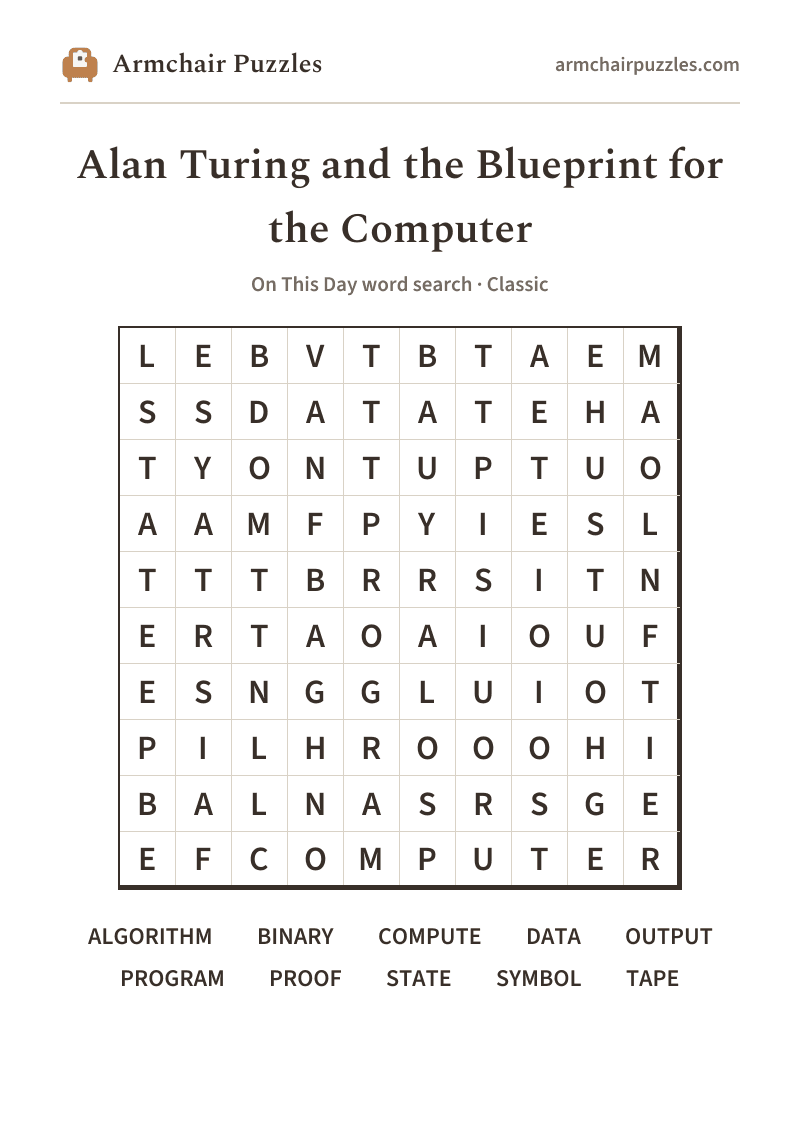
- TAPE
- In Turing's theoretical model, an infinite tape divided into squares was where the machine read and wrote its symbols, a simple idea that captured the essence of all computation.Find this word in the grid to read its note.
- ALGORITHM
- The word algorithm predates computers by centuries, but Turing's 1936 paper gave the concept its modern mathematical precision, a step-by-step procedure a machine could carry out without human judgment.Find this word in the grid to read its note.
- BINARY
- Modern computers reduce every calculation to just two states, 0 and 1, a direct echo of the on/off, yes/no logic that sat at the heart of Turing's theoretical machine.Find this word in the grid to read its note.
- PROOF
- Turing's 1936 paper was, at its core, a work of pure mathematics, a rigorous proof about what could and could not be computed, written years before a working electronic computer existed.Find this word in the grid to read its note.
armchairpuzzles.com · free large-print word searches
Alan Turing word search
Alan Turing and the Blueprint for the Computer: a free online word search
Alan Turing word search, playable online right now. Born June 23, 1912, the man who sketched the theoretical machine before silicon existed.
About Alan Turing and the Blueprint for the Computer
On June 23, 1912, Alan Turing was born in London, a mathematician whose 1936 paper "On Computable Numbers" described a theoretical machine that could follow any sequence of logical rules, solving problems by reading and writing symbols on an endless tape. That quiet, abstract idea became the conceptual engine behind every computer ever built. Long before circuits and code filled the world, it was pure mathematical thought, logic, proof, and the faith that a symbol on a tape could change everything.
How to play
- 1Find a word.Tap its first letter, then tap along to its last. The trail fills in and finishes itself when it spells a word. Or press the first letter and drag.
- 2Words run in straight lines.Across and down, and on the harder difficulties diagonally and backwards.
- 3It marks itself.Each word you find takes on its own soft color on the grid and is crossed off the list.
- 4Choose a difficulty.Relaxed, Classic or Challenging set those directions and how much the word list helps, never the grid size. Tap the A buttons at the top to enlarge the letters, or pinch the grid.
Prefer pen and paper?
A clean, large-print sheet. Free, and no sign-up.
More to explore:All On This Day word searchesPrintable On This Day word searches