Use the arrow keys to move between letters. Press Enter or Space on the first letter of a word, then again on the last letter. Press Escape to cancel.
A few of the words
- SILK
- Franklin chose a silk kite rather than paper because silk holds up better in wet conditions, a practical detail that made the experiment possible.Find this word in the grid to read its note.
- KEY
- The metal key dangling from the kite string conducted electrical charge down the wet hemp line to Franklin's waiting knuckle, completing the circuit.Find this word in the grid to read its note.
- ROD
- The lightning rod followed directly from this experiment, Franklin had already described the concept in 1750, and the kite gave him the proof he needed.Find this word in the grid to read its note.
- FRANKLIN
- Benjamin Franklin published his electrical findings in London in 1751, a year before the kite flight, making him already famous in scientific circles when the storm confirmed his theory.Find this word in the grid to read its note.
armchairpuzzles.com · free large-print word searches
Benjamin Franklin lightning kite experiment word search
Benjamin Franklin's Lightning Kite: a free online word search
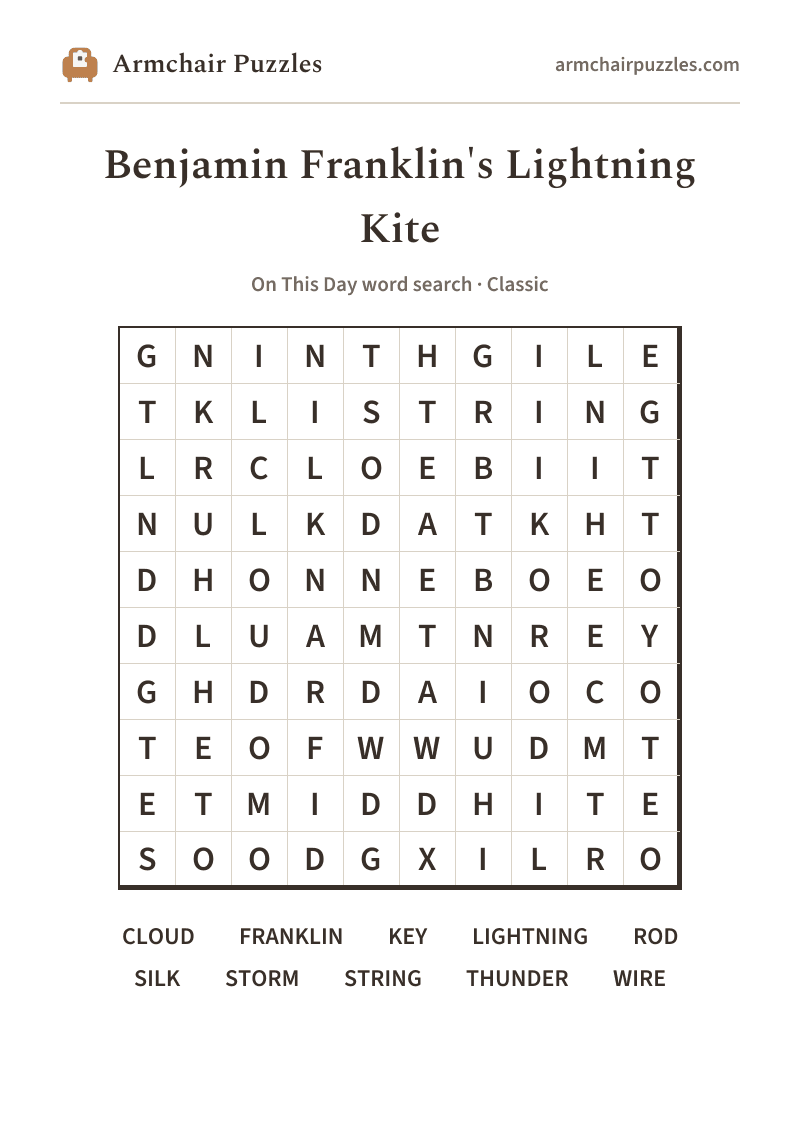
Benjamin Franklin's lightning kite experiment word search, set in the stormy Philadelphia summer of 1752, when a key on a string changed everything.
About Benjamin Franklin's Lightning Kite
On June 15, 1752, Benjamin Franklin stood in a Philadelphia field as a thunderstorm rolled in, holding a silk kite with a metal key tied to its string, and felt the jolt that proved lightning was electrical in nature. The experiment didn't just satisfy curiosity; it led directly to the invention of the lightning rod, sparing countless buildings and ships from destruction. Franklin's storm-soaked moment of clarity stands as one of the great turning points in the history of science, transforming lightning from a terrifying mystery into a force that could be understood, and tamed.
How to play
- 1Find a word.Tap its first letter, then tap along to its last. The trail fills in and finishes itself when it spells a word. Or press the first letter and drag.
- 2Words run in straight lines.Across and down, and on the harder difficulties diagonally and backwards.
- 3It marks itself.Each word you find takes on its own soft colour on the grid and is crossed off the list.
- 4Choose a difficulty.Relaxed, Classic or Challenging set those directions and how much the word list helps, never the grid size. Tap the A buttons at the top to enlarge the letters, or pinch the grid.
Prefer pen and paper?
A clean, large-print sheet. Free, and no sign-up.
More to explore:All On This Day word searchesPrintable On This Day word searches
↑ Back to the puzzle