Word 1 of 10: MIDNIGHT
Use the arrow keys to move between letters. Press Enter or Space on the first letter of a word, then again on the last letter. Press Escape to cancel.
A few of the words
- BURNS
- Robert Burns sent his version of the poem to the Scots Musical Museum in 1788, describing it as 'an old song of olden times' that he had collected from a local singer.Find this word in the grid to read its note.
- SYNE
- In Scots, 'syne' means 'since' or 'ago', so 'auld lang syne' carries the quiet weight of 'long, long ago.'Find this word in the grid to read its note.
- MIDNIGHT
- The tradition of marking the exact stroke of midnight as the year's turning point dates back centuries and is still the emotional peak of New Year's celebrations worldwide.Find this word in the grid to read its note.
- CIRCLE
- The familiar image of a circle of joined, crossed arms comes from a long-standing custom at the song's final verse, hands held, swung gently, as the chorus rises.Find this word in the grid to read its note.
armchairpuzzles.com · free large-print word searches
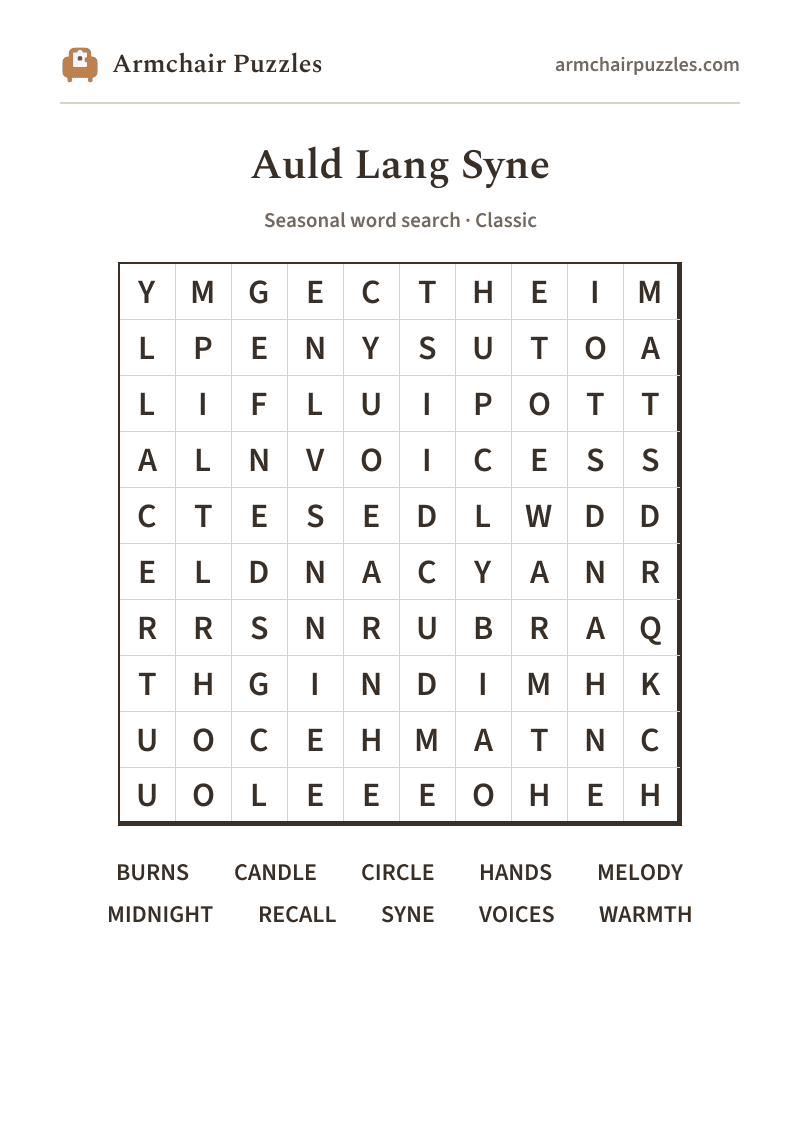
Auld Lang Syne word search
Auld Lang Syne: a free online word search
Auld Lang Syne word search, free to play online right now, for the song, the toast, the linked hands, and one shining midnight.
About Auld Lang Syne
Every New Year's Eve, in living rooms and city squares alike, millions of people join hands and sing a song most of them only half remember, and it doesn't matter at all. Robert Burns shaped "Auld Lang Syne" into the poem the world knows in 1788, drawing on an older Scottish tradition of honoring days gone by. The words mean something like "old long since", times past, old friends, the years that made us, and at midnight they feel true in a way that's hard to explain but impossible to mistake.
How to play
- 1Find a word.Tap its first letter, then tap along to its last. The trail fills in and finishes itself when it spells a word. Or press the first letter and drag.
- 2Words run in straight lines.Across and down, and on the harder difficulties diagonally and backwards.
- 3It marks itself.Each word you find takes on its own soft color on the grid and is crossed off the list.
- 4Choose a difficulty.The level you pick sets those directions and how much the word list helps, never the grid size. Tap the A buttons at the top to enlarge the letters, or pinch the grid.
Prefer pen and paper?
A clean, large-print sheet. Free, and no sign-up.
More to explore:All Seasonal word searchesPrintable Seasonal word searches