Word 1 of 10: COLLAGEN
Use the arrow keys to move between letters. Press Enter or Space on the first letter of a word, then again on the last letter. Press Escape to cancel.
A few of the words
- COLLAGEN
- Long-simmered bones release collagen into the liquid, which gives a good homemade broth its silky, almost lip-coating richness, something no store-bought carton quite matches.Find this word in the grid to read its note.
- BAYLEAF
- Bay leaves have flavored European and Mediterranean cooking for centuries; the ancient Greeks and Romans considered the laurel, the same plant, a symbol of honor and wisdom.Find this word in the grid to read its note.
- SKIMMER
- The flat, wide skimmer is one of the oldest kitchen tools in the world, cooks have been using a perforated spoon to skim foam and fat from a simmering pot since at least the medieval period.Find this word in the grid to read its note.
- MARROW
- Beef marrow bones are prized for the rich, fatty core inside, it melts into the broth during a long cook and is one of the main reasons a slow stock tastes so deeply satisfying.Find this word in the grid to read its note.
armchairpuzzles.com · free large-print word searches
stockpot word search
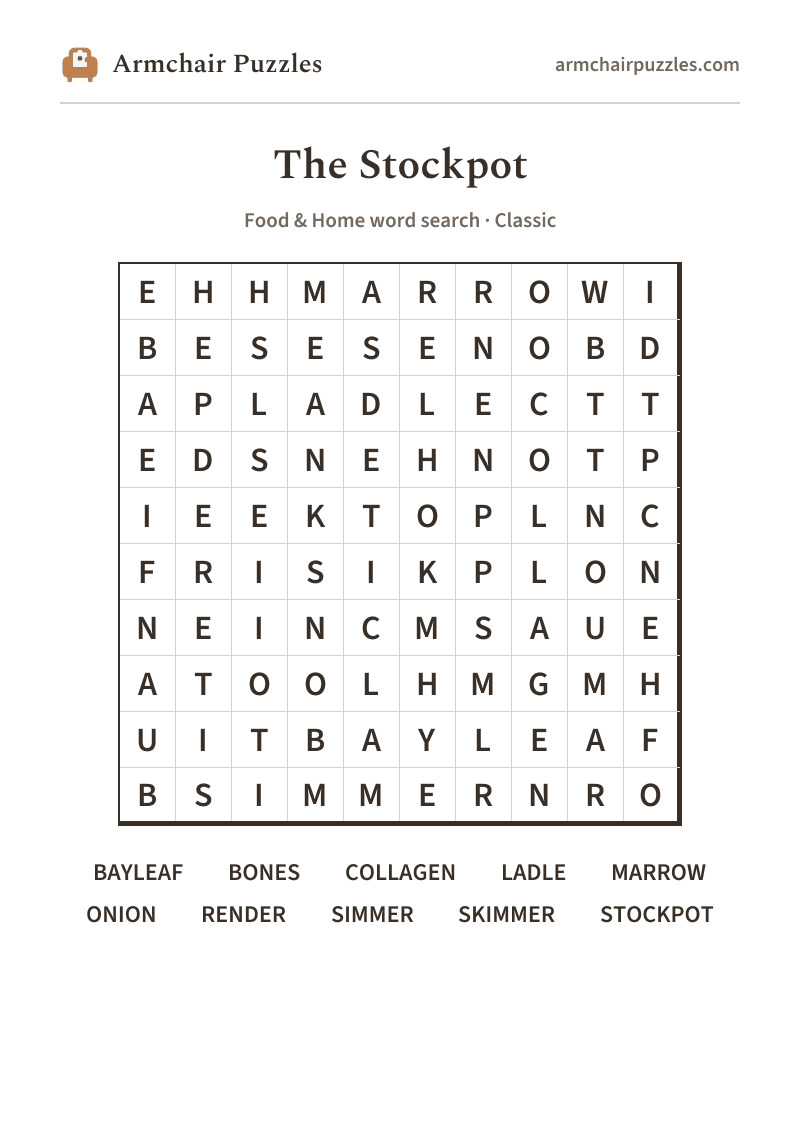
The Stockpot: a free online word search
Stockpot word search, no account to create and nothing to download. Just the puzzle and that low, patient smell of something good on the back burner.
About The Stockpot
Every great soup starts the same way, a heavy pot, cold water, and something worth simmering. Bones go in first, then the aromatics: a halved onion, a fistful of celery, a smashed clove of garlic. Hours later the kitchen smells like patience itself, and what's left in the pot is the quiet foundation of a hundred meals.
How to play
- 1Find a word.Tap its first letter, then tap along to its last. The trail fills in and finishes itself when it spells a word. Or press the first letter and drag.
- 2Words run in straight lines.Across and down, and on the harder difficulties diagonally and backwards.
- 3It marks itself.Each word you find takes on its own soft color on the grid and is crossed off the list.
- 4Choose a difficulty.The level you pick sets those directions and how much the word list helps, never the grid size. Tap the A buttons at the top to enlarge the letters, or pinch the grid.
Prefer pen and paper?
A clean, large-print sheet. Free, and no sign-up.
More to explore:All Food & Home word searchesPrintable Food & Home word searches