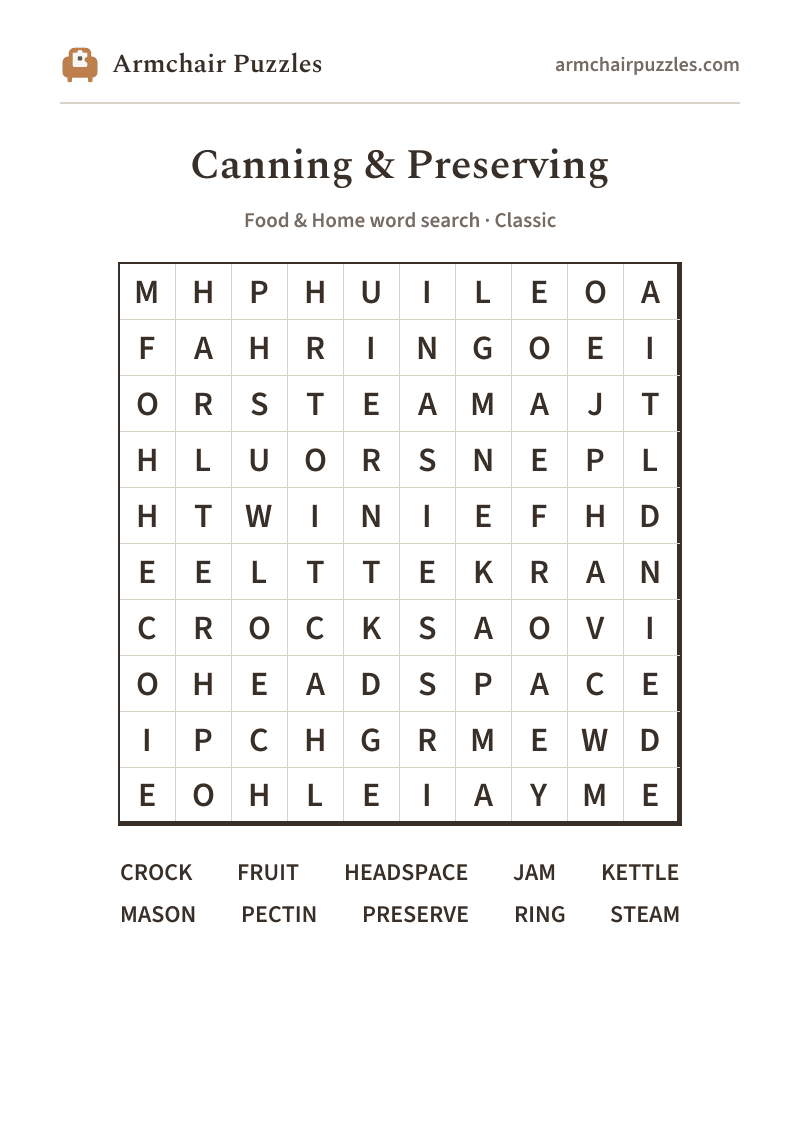
Word 1 of 10: HEADSPACE
Use the arrow keys to move between letters. Press Enter or Space on the first letter of a word, then again on the last letter. Press Escape to cancel.
A few of the words
- PECTIN
- Pectin is a naturally occurring fiber found in fruit skins and cores, it's what makes jam and jelly firm up as they cool.Find this word in the grid to read its note.
- HEADSPACE
- That small gap left between the food and the lid is called headspace, and getting it right, usually ¼ to ½ inch, is key to a proper vacuum seal.Find this word in the grid to read its note.
- MASON
- The Mason jar takes its name from John Landis Mason, who patented his threaded glass jar design in 1858.Find this word in the grid to read its note.
- CROCK
- Before the Mason jar, the stoneware crock was the go-to vessel for fermenting and preserving everything from sauerkraut to cucumber pickles.Find this word in the grid to read its note.
armchairpuzzles.com · free large-print word searches
canning and preserving word search
Canning & Preserving: a free online word search
Canning and preserving word search, free and ready to play online with no account, no app, just the quiet click of a sealed jar waiting in the puzzle.
About Canning & Preserving
A row of filled jars cooling on a kitchen towel is a deeply satisfying sight, their lids pinging one by one as the seal pulls tight. Home canning carries the flavors of a summer garden, sweet strawberry jam, tangy dill pickles, jewel-bright jelly, straight into the middle of winter. The rhythm of the process itself is meditative: sterilize, fill, wipe the rim, set the lid, and lower the jar into the rolling boil.
How to play
- 1Find a word.Tap its first letter, then tap along to its last. The trail fills in and finishes itself when it spells a word. Or press the first letter and drag.
- 2Words run in straight lines.Across and down, and on the harder difficulties diagonally and backwards.
- 3It marks itself.Each word you find takes on its own soft color on the grid and is crossed off the list.
- 4Choose a difficulty.The level you pick sets those directions and how much the word list helps, never the grid size. Tap the A buttons at the top to enlarge the letters, or pinch the grid.
Prefer pen and paper?
A clean, large-print sheet. Free, and no sign-up.
More to explore:All Food & Home word searchesPrintable Food & Home word searches