Word 1 of 10: CHECKER
Use the arrow keys to move between letters. Press Enter or Space on the first letter of a word, then again on the last letter. Press Escape to cancel.
A few of the words
- BISHOP
- In chess, the bishop moves diagonally and can cover the entire diagonal it starts on, but only ever in one color square for the whole game.Find this word in the grid to read its note.
- DOMINO
- The word 'domino' likely comes from a black-and-white masquerade hood worn in Europe; the game itself was popular in 18th-century France and spread quickly from there.Find this word in the grid to read its note.
- CASTLE
- Castling is one of chess's most distinctive moves, the only time a player can move two pieces in a single turn, tucking the king safely behind a rook.Find this word in the grid to read its note.
- CHECKER
- A standard checkerboard has 64 squares in an 8×8 grid, the same board shared with chess, though checkers uses only the dark squares for play.Find this word in the grid to read its note.
armchairpuzzles.com · free large-print word searches
board games word search
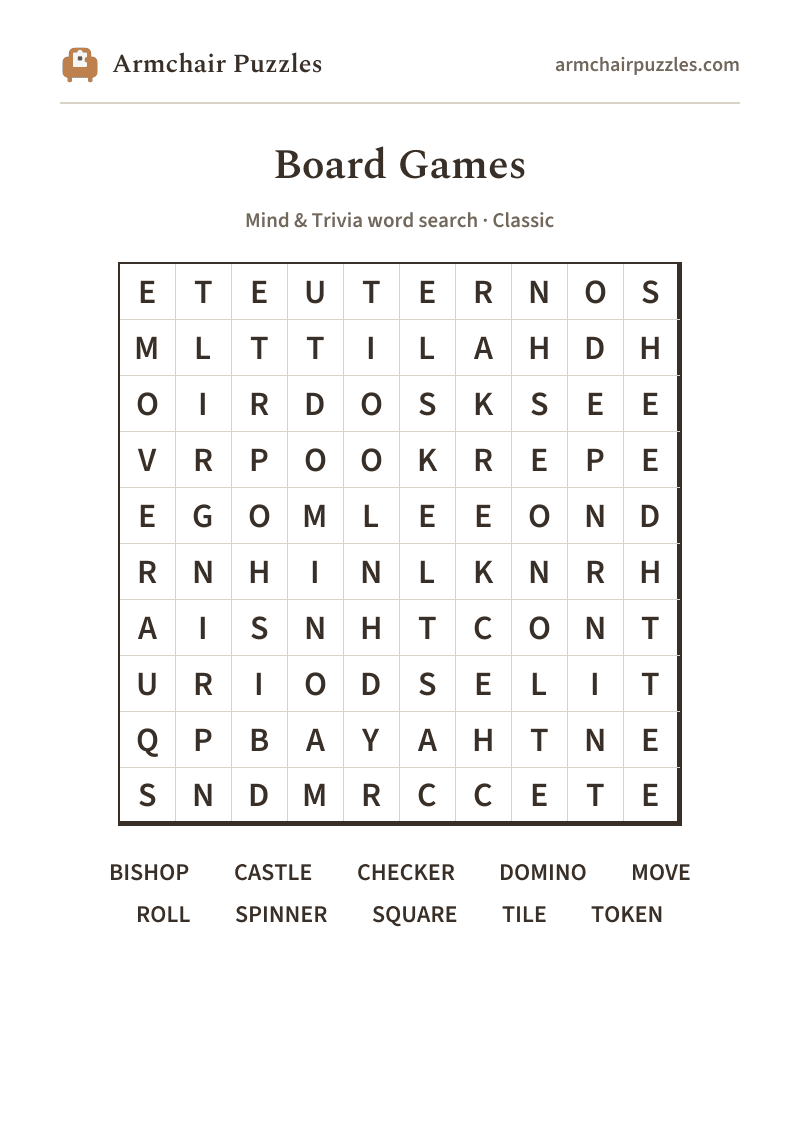
Board Games: a free online word search
Board games word search, playable online right now, where CHESS and DOMINOES wait alongside the clack and rattle of a proper game night.
About Board Games
Long before screens lit up the living room, a folded board and a handful of pieces were all a family needed for an evening of friendly rivalry. Chess has been played for well over a thousand years, while checkers traces its roots to ancient Egypt and the Mediterranean world. Dominoes arrived in Europe by the 18th century, and the satisfying click of tiles on a table remains one of the most familiar sounds of a game night at home.
How to play
- 1Find a word.Tap its first letter, then tap along to its last. The trail fills in and finishes itself when it spells a word. Or press the first letter and drag.
- 2Words run in straight lines.Across and down, and on the harder difficulties diagonally and backwards.
- 3It marks itself.Each word you find takes on its own soft color on the grid and is crossed off the list.
- 4Choose a difficulty.The level you pick sets those directions and how much the word list helps, never the grid size. Tap the A buttons at the top to enlarge the letters, or pinch the grid.
Prefer pen and paper?
A clean, large-print sheet. Free, and no sign-up.