Word 1 of 10: BLISSFUL
Use the arrow keys to move between letters. Press Enter or Space on the first letter of a word, then again on the last letter. Press Escape to cancel.
A few of the words
- BLITHE
- One of the oldest happy words in English, blithe appeared in Old English as 'blīþe', meaning gentle and pleasant, the sense of carefree joy came later.Find this word in the grid to read its note.
- JOLLY
- Jolly arrived in English from Old French 'jolif', thought to be linked to the Old Norse word for Yule, carrying festive, midwinter warmth from the very start.Find this word in the grid to read its note.
- ELATED
- From the Latin 'elatus', meaning lifted or carried high, elated is the word for happiness with actual altitude.Find this word in the grid to read its note.
- BUOYANT
- Borrowed from the world of sailing, buoyant literally means able to float, making it a perfect metaphor for a mood that simply refuses to sink.Find this word in the grid to read its note.
armchairpuzzles.com · free large-print word searches
happy words word search
Happy Words: a free online word search
Happy words word search, free and playable online without an account or anything to install. ELATED and JUBILANT are waiting.
About Happy Words
English is unusually generous when it comes to shades of happiness, glad carries a quiet gratitude, jolly a rosy, round-cheeked warmth, and elated lifts clean off the ground. Some of these words have traveled centuries to reach us: blithe traces back to Old English, where it simply meant gentle and kind before joy folded into its meaning. Collecting them side by side is a small reminder that the language has always taken cheerfulness seriously.
How to play
- 1Find a word.Tap its first letter, then tap along to its last. The trail fills in and finishes itself when it spells a word. Or press the first letter and drag.
- 2Words run in straight lines.Across and down, and on the harder difficulties diagonally and backwards.
- 3It marks itself.Each word you find takes on its own soft color on the grid and is crossed off the list.
- 4Choose a difficulty.The level you pick sets those directions and how much the word list helps, never the grid size. Tap the A buttons at the top to enlarge the letters, or pinch the grid.
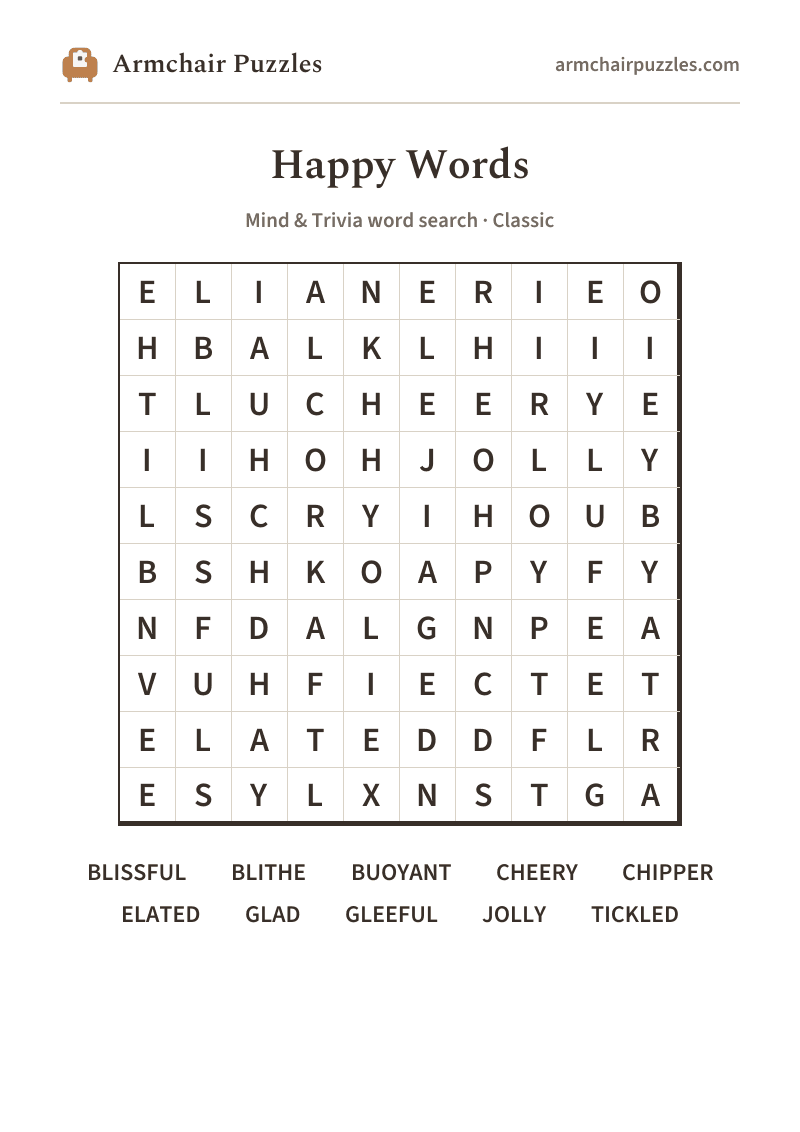
Prefer pen and paper?
A clean, large-print sheet. Free, and no sign-up.