Use the arrow keys to move between letters. Press Enter or Space on the first letter of a word, then again on the last letter. Press Escape to cancel.
A few of the words
- CATHODE
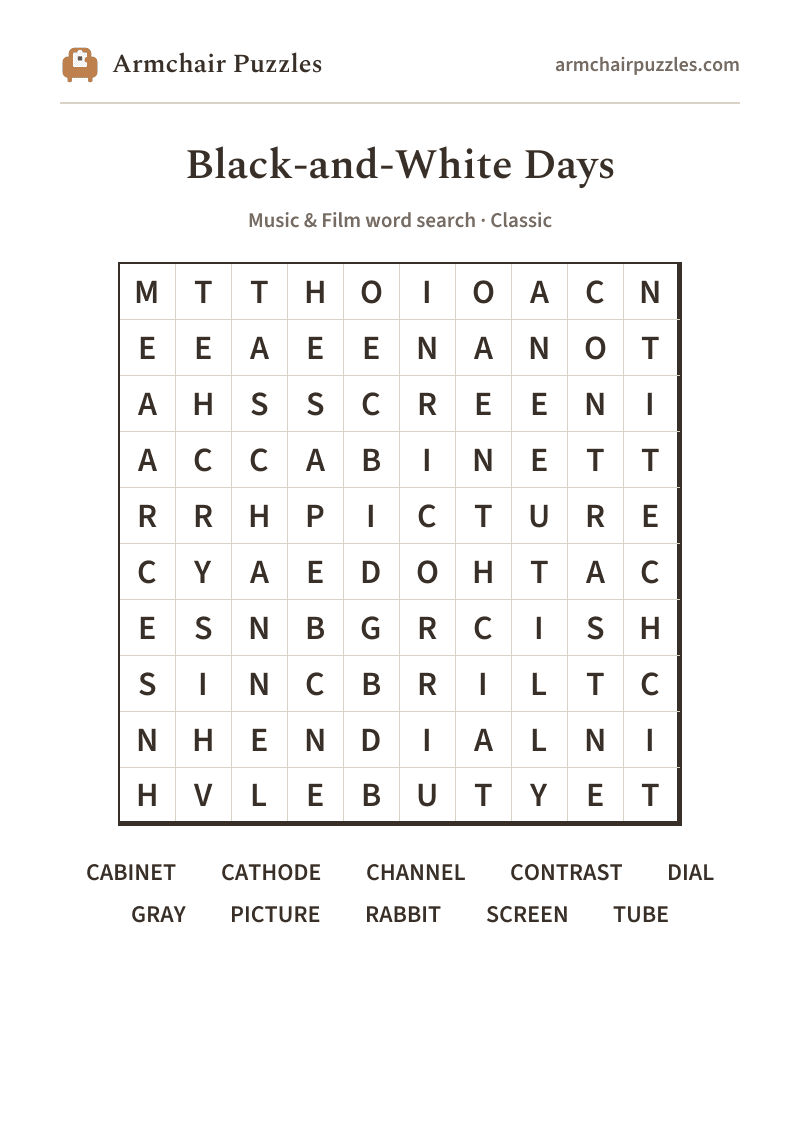
- The cathode ray tube, or CRT, fired a beam of electrons at a phosphor-coated screen to paint each frame line by line, a technology that defined home television from the late 1940s through the 1990s.Find this word in the grid to read its note.
- RABBIT
- Rabbit-ear antennas became a fixture on TV sets after the first consumer sets appeared in the late 1940s; the twin-rod design could be spread wide or crossed tight, and every household had its own secret angle for the best signal.Find this word in the grid to read its note.
- CONTRAST
- Because early broadcast cameras had a limited tonal range, directors and lighting designers learned to use stark contrast, deep blacks against bright whites, as an expressive tool, giving classic live TV its distinctive theatrical look.Find this word in the grid to read its note.
- CABINET
- Early television sets were marketed as furniture: console models from manufacturers like RCA and Zenith arrived in handsome wood cabinets designed to sit proudly in the living room alongside the radio it was quietly replacing.Find this word in the grid to read its note.
armchairpuzzles.com · free large-print word searches
black and white TV word search
Black-and-White Days: a free online word search
Black and white TV word search, playable online right now, back when Cronkite's voice came out of a glowing gray box and that was enough.
About Black-and-White Days
Before color arrived in living rooms, television spoke entirely in shades of gray, deep shadows pooling behind furniture, faces lit hard against plain plaster walls, every scene etched in crisp contrast. The screen itself sat inside a wooden cabinet like a tiny stage, its round-cornered picture glowing cool and silver in a darkened room. Rabbit-ear antennas perched on top, tilted just so, coaxing a clean signal out of the air while the family leaned forward and squinted at the flicker.
How to play
- 1Find a word.Tap its first letter, then tap along to its last. The trail fills in and finishes itself when it spells a word. Or press the first letter and drag.
- 2Words run in straight lines.Across and down, and on the harder difficulties diagonally and backwards.
- 3It marks itself.Each word you find takes on its own soft color on the grid and is crossed off the list.
- 4Choose a difficulty.Relaxed, Classic or Challenging set those directions and how much the word list helps, never the grid size. Tap the A buttons at the top to enlarge the letters, or pinch the grid.
Prefer pen and paper?
A clean, large-print sheet. Free, and no sign-up.