Use the arrow keys to move between letters. Press Enter or Space on the first letter of a word, then again on the last letter. Press Escape to cancel.
A few of the words
- SYNDICATE
- A show sold into syndication could air on dozens of local stations simultaneously, *M*A*S*H* and I Love Lucy both found enormous second lives this way long after their original network runs ended.Find this word in the grid to read its note.
- PILOT
- The pilot episode is the one that started it all, a single audition episode pitched to the network, sometimes filmed years before the full series was greenlit.Find this word in the grid to read its note.
- PRIMETIME
- The 8–11 p.m. window became known as primetime because it drew the largest nightly audience, making it the most valuable real estate on the broadcast schedule.Find this word in the grid to read its note.
- FINALE
- A series finale could draw staggering numbers, the 1983 finale of *M*A*S*H* remains one of the most-watched single episodes in American television history.Find this word in the grid to read its note.
armchairpuzzles.com · free large-print word searches
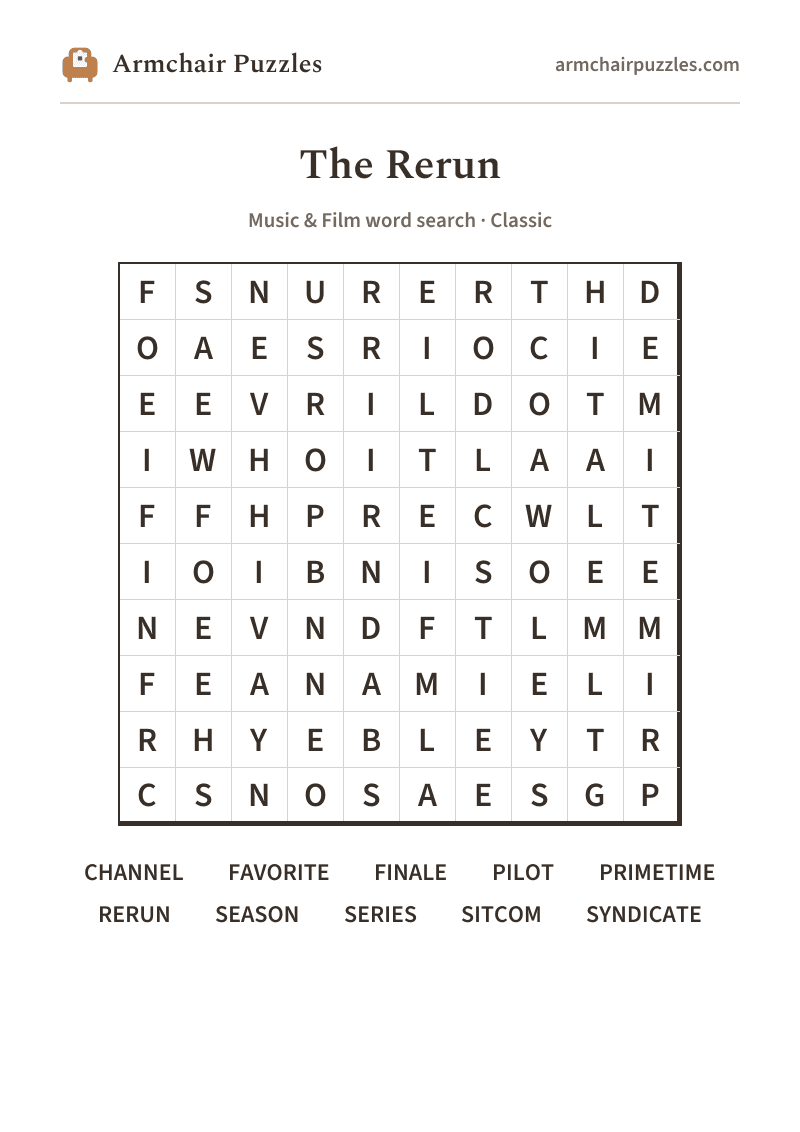
rerun word search
The Rerun: a free online word search
Rerun word search, no sign-up and nothing to pay, with the classic sitcoms that filled every weeknight for decades.
About The Rerun
Before streaming, the rerun was a gift, a summer evening when a beloved episode found its way back to your screen without any effort on your part. You settled into the couch, recognized the opening notes of the theme song, and felt the quiet pleasure of knowing exactly what was coming. Network schedules were planned months in advance, and a show's life in syndication often outlasted its original run by decades.
How to play
- 1Find a word.Tap its first letter, then tap along to its last. The trail fills in and finishes itself when it spells a word. Or press the first letter and drag.
- 2Words run in straight lines.Across and down, and on the harder difficulties diagonally and backwards.
- 3It marks itself.Each word you find takes on its own soft color on the grid and is crossed off the list.
- 4Choose a difficulty.Relaxed, Classic or Challenging set those directions and how much the word list helps, never the grid size. Tap the A buttons at the top to enlarge the letters, or pinch the grid.
Prefer pen and paper?
A clean, large-print sheet. Free, and no sign-up.