Use the arrow keys to move between letters. Press Enter or Space on the first letter of a word, then again on the last letter. Press Escape to cancel.
A few of the words
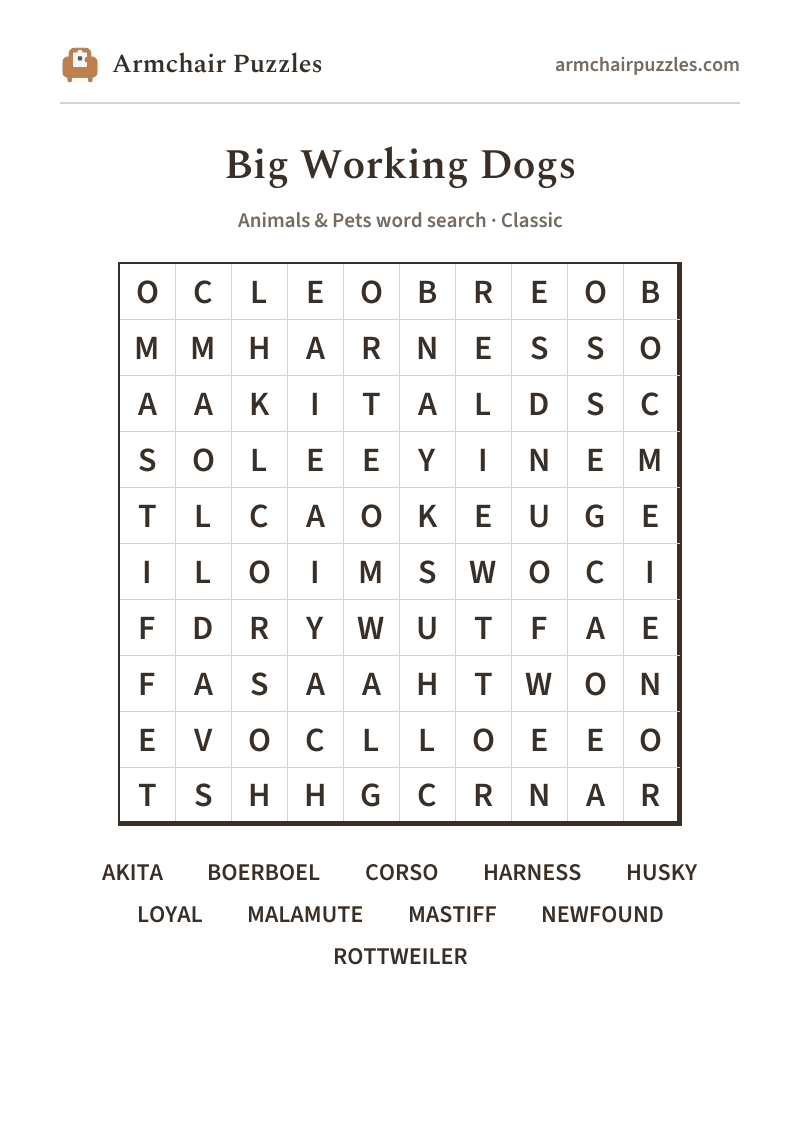
- MASTIFF
- The English Mastiff is one of the heaviest dog breeds in the world, with some individuals recorded above 200 pounds. Their calm, patient temperament earned them the nickname 'gentle giants'.Find this word in the grid to read its note.
- HUSKY
- The Siberian Husky was developed by the Chukchi people of northeastern Siberia to pull light sleds across vast distances in extreme cold, a tradition stretching back thousands of years.Find this word in the grid to read its note.
- ROTTWEILER
- Rottweilers take their name from the German town of Rottweil, where they were used for centuries to herd livestock and pull butchers' carts to market.Find this word in the grid to read its note.
- MALAMUTE
- The Alaskan Malamute is named after the Mahlemiut Inuit people of Alaska, who bred this powerful dog to haul heavy loads across snow and ice.Find this word in the grid to read its note.
armchairpuzzles.com · free large-print word searches
big working dogs word search
Big Working Dogs: a free online word search
Big working dogs word search, free to play online. The Mastiff, the Husky, the breeds built for weather and work.
About Big Working Dogs
Working dogs have stood beside people for thousands of years, pulling sleds across frozen tundra, guarding livestock on mountain passes, and keeping watch over homesteads through the night. Breeds like the Rottweiler and Doberman were shaped by the demanding jobs people needed them to do, and that heritage shows in every steady, purposeful stride. There is a quiet nobility to a big working dog at rest: calm, attentive, and completely at home in a world that needs them.
How to play
- 1Find a word.Tap its first letter, then tap along to its last. The trail fills in and finishes itself when it spells a word. Or press the first letter and drag.
- 2Words run in straight lines.Across and down, and on the harder difficulties diagonally and backwards.
- 3It marks itself.Each word you find takes on its own soft color on the grid and is crossed off the list.
- 4Choose a difficulty.Relaxed, Classic or Challenging set those directions and how much the word list helps, never the grid size. Tap the A buttons at the top to enlarge the letters, or pinch the grid.
Prefer pen and paper?
A clean, large-print sheet. Free, and no sign-up.