Use the arrow keys to move between letters. Press Enter or Space on the first letter of a word, then again on the last letter. Press Escape to cancel.
A few of the words
- WRETCH
- Newton's unflinching word for himself, "a wretch like me", lends the hymn its raw, unguarded honesty that listeners have found healing for over two centuries.Find this word in the grid to read its note.
- FOUND
- "I once was lost, but now am found" pairs with "was blind, but now I see", two of the most recognized couplets in all of English-language hymnody.Find this word in the grid to read its note.
- SWEET
- The very first line asks how "sweet the sound", that single sensory word, sweet, sets the hymn's whole tone of tender wonder before another word is sung.Find this word in the grid to read its note.
- HEAVEN
- The final verses of "Amazing Grace" look forward to ten thousand years of praise, a vision of eternity that has given comfort at countless bedsides and gravesides.Find this word in the grid to read its note.
armchairpuzzles.com · free large-print word searches
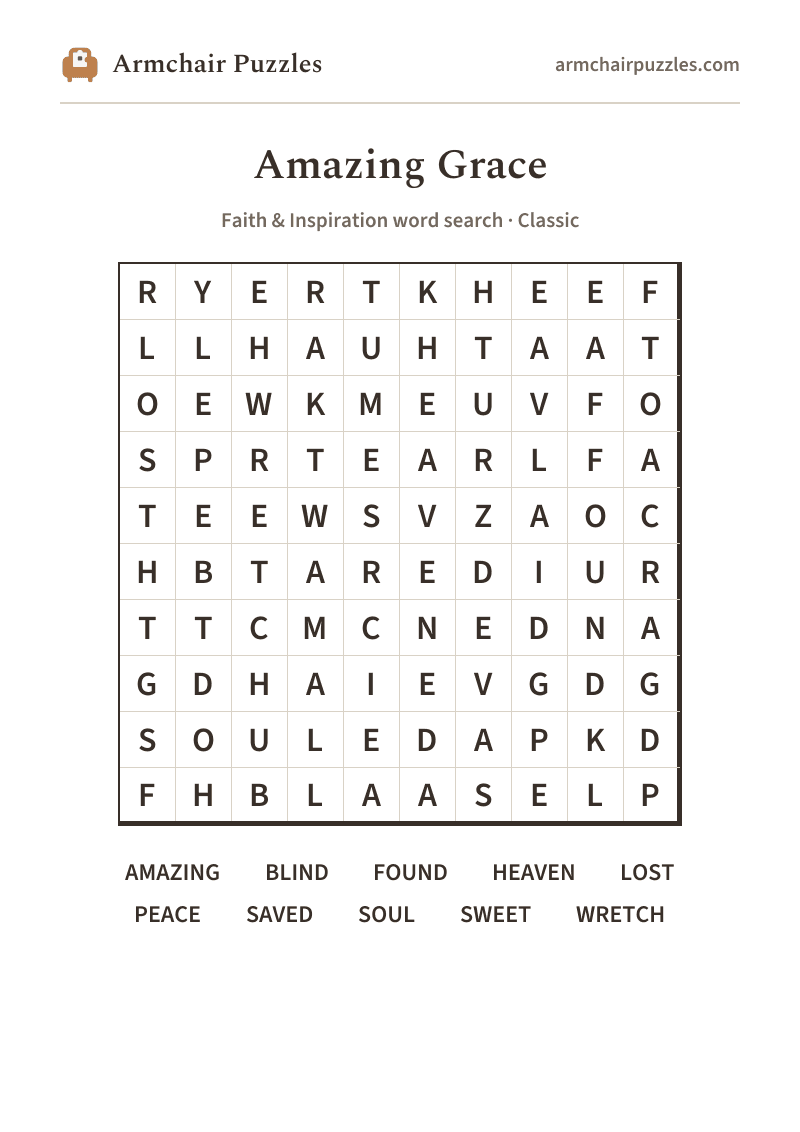
Amazing Grace word search
Amazing Grace: a free online word search
Amazing Grace word search, free to play and print, built around the hymn John Newton wrote in 1772 after a storm at sea changed everything.
About Amazing Grace
Few songs have crossed as many thresholds, church pews, hillside funerals, candlelit vigils, as "Amazing Grace." John Newton, a former slave-trade captain who underwent a profound conversion, wrote the words around 1772, and they have been sung ever since by voices in every language and tradition. The melody most Americans know, called "New Britain," is a pentatonic American folk tune that became forever wedded to Newton's words in the early 1800s, giving the hymn its quietly timeless, unhurried feeling.
How to play
- 1Find a word.Tap its first letter, then tap along to its last. The trail fills in and finishes itself when it spells a word. Or press the first letter and drag.
- 2Words run in straight lines.Across and down, and on the harder difficulties diagonally and backwards.
- 3It marks itself.Each word you find takes on its own soft color on the grid and is crossed off the list.
- 4Choose a difficulty.The level you pick sets those directions and how much the word list helps, never the grid size. Tap the A buttons at the top to enlarge the letters, or pinch the grid.
Prefer pen and paper?
A clean, large-print sheet. Free, and no sign-up.