Word 1 of 10: PADDINGTON
Use the arrow keys to move between letters. Press Enter or Space on the first letter of a word, then again on the last letter. Press Escape to cancel.
A few of the words
- VELVETEEN
- The Velveteen Rabbit, published in 1922 by Margery Williams, asks one of children's literature's oldest questions: what makes a toy real?Find this word in the grid to read its note.
- PADDINGTON
- Paddington Bear arrived at a London station with a label reading 'Please look after this bear' in Michael Bond's 1958 debut.Find this word in the grid to read its note.
- MOWGLI
- Rudyard Kipling's jungle-raised boy first appeared in The Jungle Book in 1894, raised by wolves and tutored by a bear named Baloo.Find this word in the grid to read its note.
- PIPPI
- Pippi Longstocking, Astrid Lindgren's irrepressible red-haired heroine, made her debut in Sweden in 1945 and has been delighting readers ever since.Find this word in the grid to read its note.
armchairpuzzles.com · free large-print word searches
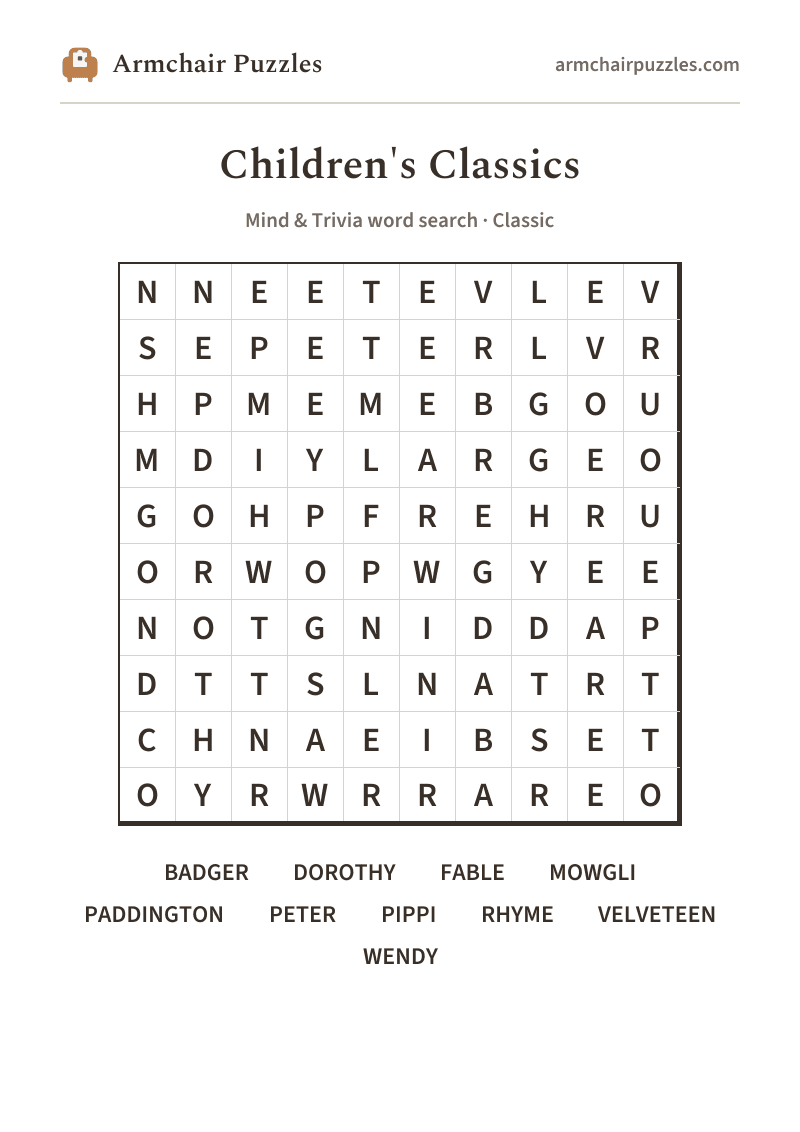
Children's Classics word search
Children's Classics: a free online word search
Children's Classics word search, playable online right now, with PETER, POOH, and the rest of the nursery shelf waiting for you.
About Children's Classics
The stories that find us earliest tend to stay longest, a velveteen rabbit worn soft by imagining, a bear of very little brain who somehow gets everything right, a girl who steps through a looking-glass into a world of beautiful nonsense. These are the books read aloud by lamplight, the pictures studied long after bedtime, the rhymes that surface whole and unbidden decades later. They belong less to childhood than to the imagination itself.
How to play
- 1Find a word.Tap its first letter, then tap along to its last. The trail fills in and finishes itself when it spells a word. Or press the first letter and drag.
- 2Words run in straight lines.Across and down, and on the harder difficulties diagonally and backwards.
- 3It marks itself.Each word you find takes on its own soft color on the grid and is crossed off the list.
- 4Choose a difficulty.The level you pick sets those directions and how much the word list helps, never the grid size. Tap the A buttons at the top to enlarge the letters, or pinch the grid.
Prefer pen and paper?
A clean, large-print sheet. Free, and no sign-up.