Word 1 of 10: TOLSTOY
Use the arrow keys to move between letters. Press Enter or Space on the first letter of a word, then again on the last letter. Press Escape to cancel.
A few of the words
- TWAIN
- Samuel Clemens took the name from riverboat slang. Mark twain meant two fathoms deep, a safe depth for a steamboat on the Mississippi.Find this word in the grid to read its note.
- BRONTE
- Charlotte, Emily, and Anne all published in 1847 under the male-sounding pen names Currer, Ellis, and Acton Bell.Find this word in the grid to read its note.
- TOLSTOY
- War and Peace first appeared in installments in the Russian Messenger in the 1860s, long before it became the famous doorstop.Find this word in the grid to read its note.
- ORWELL
- Eric Blair chose the pen name George Orwell, borrowing the name of the River Orwell in Suffolk, England.Find this word in the grid to read its note.
armchairpuzzles.com · free large-print word searches
authors word search
Authors on Every Shelf: a free online word search
Authors word search, free and printable, with the surnames you'd find alphabetized on any library shelf, from Tolstoy to Twain.
About Authors on Every Shelf
Walk down the fiction aisle of nearly any public library and the spines read like a roll call: Austen, Hugo, Eliot, Steinbeck, shelved in strict alphabetical order. Some of these writers lived in drafty English parsonages, some in Russian country estates, and one learned the river from a pilot's wheel. Their names stay on the shelf because someone keeps checking the books out.
How to play
- 1Find a word.Tap its first letter, then tap along to its last. The trail fills in and finishes itself when it spells a word. Or press the first letter and drag.
- 2Words run in straight lines.Across and down, and on the harder difficulties diagonally and backwards.
- 3It marks itself.Each word you find takes on its own soft color on the grid and is crossed off the list.
- 4Choose a difficulty.The level you pick sets those directions and how much the word list helps, never the grid size. Tap the A buttons at the top to enlarge the letters, or pinch the grid.
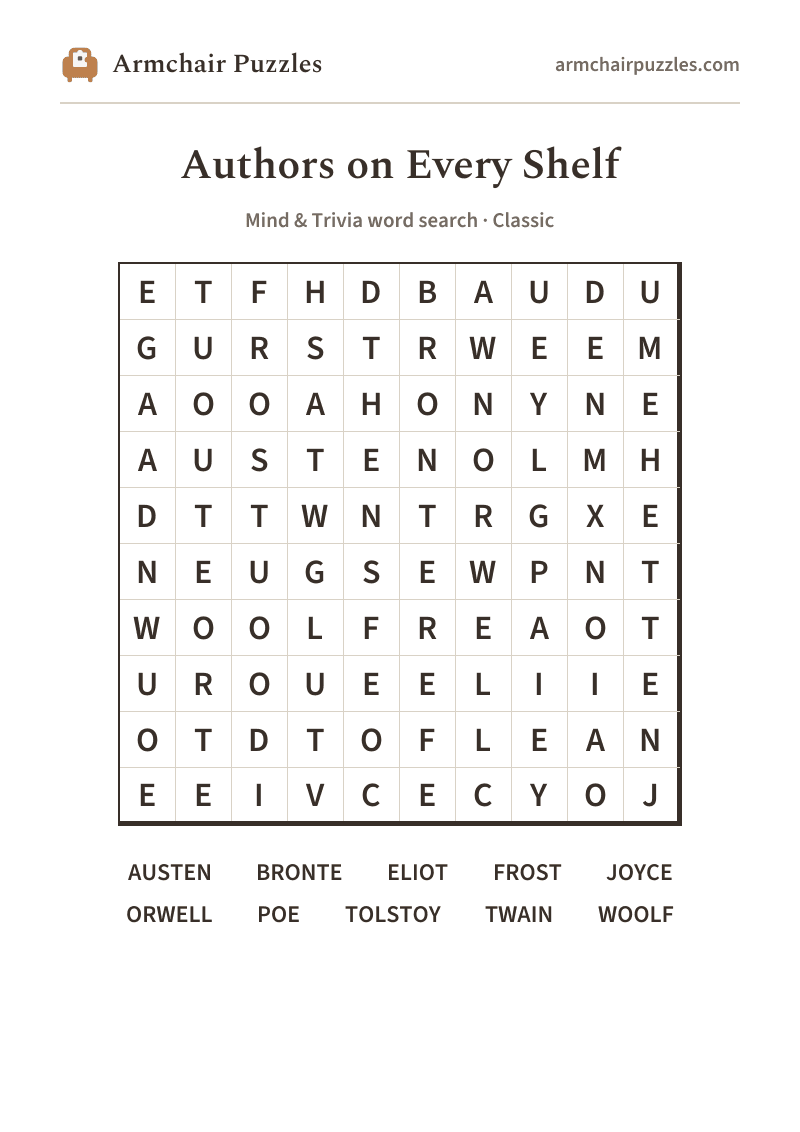
Prefer pen and paper?
A clean, large-print sheet. Free, and no sign-up.