Word 1 of 10: QUATRAIN
Use the arrow keys to move between letters. Press Enter or Space on the first letter of a word, then again on the last letter. Press Escape to cancel.
A few of the words
- SONNET
- The sonnet's 14-line form was perfected in 14th-century Italy by Petrarch, whose love poems to Laura set the template that Shakespeare would later make his own.Find this word in the grid to read its note.
- HAIKU
- The haiku as we know it was shaped by the Japanese poet Matsuo Bashō in the 17th century, three lines capturing a single moment in nature with striking economy.Find this word in the grid to read its note.
- IAMBIC
- Iambic pentameter, ten syllables to a line, alternating unstressed and stressed, became the heartbeat of English verse, used by poets from Chaucer to Keats.Find this word in the grid to read its note.
- ELEGY
- An elegy is a poem of mourning and reflection; Thomas Gray's 'Elegy Written in a Country Churchyard,' published in 1751, remains one of the most beloved in the English language.Find this word in the grid to read its note.
armchairpuzzles.com · free large-print word searches
poetry word search
Poetry: a free online word search
Poetry word search, where sonnet and stanza sit waiting on the page like lines a good teacher once made you memorize.
About Poetry
Poetry is one of the oldest arts, older than the written word itself, passed mouth to ear long before ink met parchment. Every culture has shaped it differently: the disciplined fourteen lines of the sonnet, the spare seasonal breath of the haiku, the rolling music of the ballad. What holds them all together is the feeling that each word has been placed exactly where it belongs.
How to play
- 1Find a word.Tap its first letter, then tap along to its last. The trail fills in and finishes itself when it spells a word. Or press the first letter and drag.
- 2Words run in straight lines.Across and down, and on the harder difficulties diagonally and backwards.
- 3It marks itself.Each word you find takes on its own soft color on the grid and is crossed off the list.
- 4Choose a difficulty.The level you pick sets those directions and how much the word list helps, never the grid size. Tap the A buttons at the top to enlarge the letters, or pinch the grid.
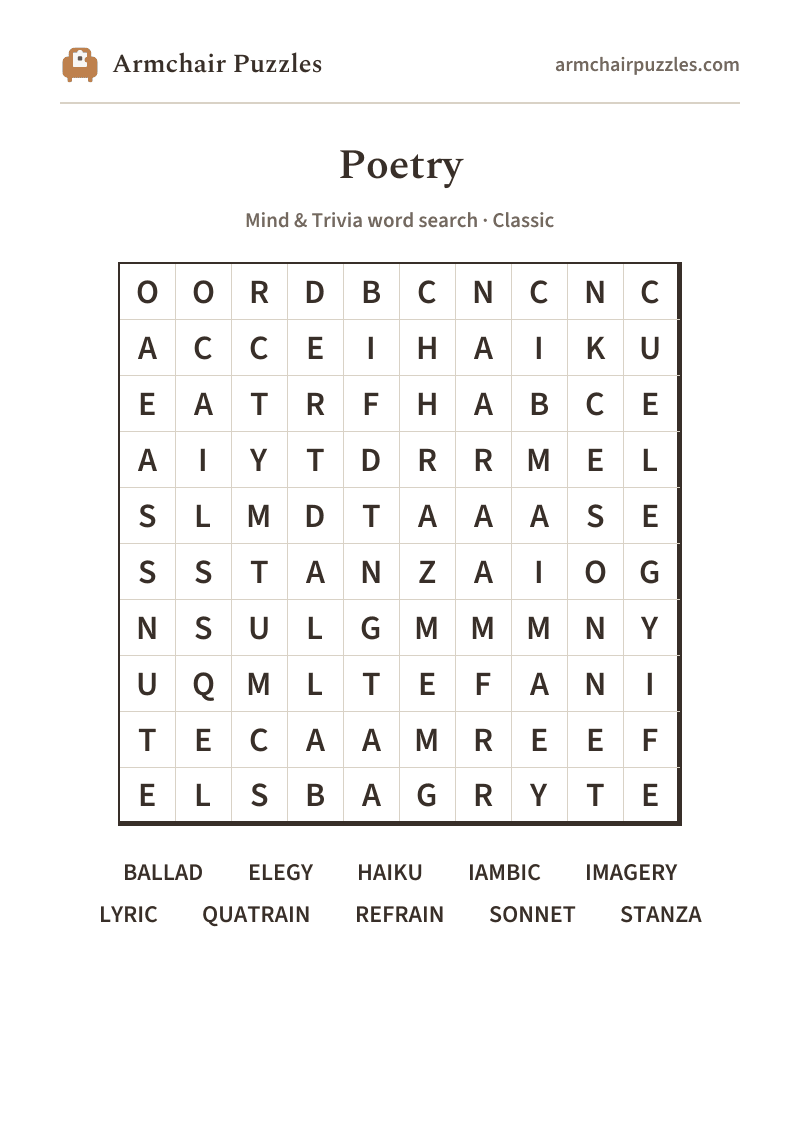
Prefer pen and paper?
A clean, large-print sheet. Free, and no sign-up.