Word 1 of 10: CHARLESTON
Use the arrow keys to move between letters. Press Enter or Space on the first letter of a word, then again on the last letter. Press Escape to cancel.
A few of the words
- LINDY
- The Lindy Hop is named after aviator Charles Lindbergh, who crossed the Atlantic solo in 1927, a feat so thrilling that dancers in Harlem coined the name almost overnight.Find this word in the grid to read its note.
- JITTERBUG
- Fast, energetic, and wonderfully acrobatic, the jitterbug was a staple of 1940s dance halls and became one of the defining images of the swing era.Find this word in the grid to read its note.
- ZOOT
- The zoot suit, wide-shouldered, high-waisted, and eye-catching, was the signature look on the dance floor in the early 1940s, worn with pride by swing dancers coast to coast.Find this word in the grid to read its note.
- BANDSTAND
- American Bandstand brought the dance floor into living rooms starting in 1952, letting a whole generation watch, and copy, the latest swing and jive steps from their own sofas.Find this word in the grid to read its note.
armchairpuzzles.com · free large-print word searches
swing dancing word search
Swing Dancing: a free online word search
Swing dancing word search, playable online the moment you land here. Hear the brass, feel the bounce, and find LINDY and JIVE hiding in the dance hall.
About Swing Dancing
When the big bands played, the dance floor came alive with flying skirts, polished shoes, and partners tossed into the air. The Lindy Hop took its name from Charles Lindbergh's 1927 transatlantic flight, and it never really stopped moving. From the Savoy Ballroom in Harlem to Saturday nights in small-town gymnasiums, swing dancing gave everyone a reason to dress sharp and stay on their feet until the last song faded.
How to play
- 1Find a word.Tap its first letter, then tap along to its last. The trail fills in and finishes itself when it spells a word. Or press the first letter and drag.
- 2Words run in straight lines.Across and down, and on the harder difficulties diagonally and backwards.
- 3It marks itself.Each word you find takes on its own soft color on the grid and is crossed off the list.
- 4Choose a difficulty.The level you pick sets those directions and how much the word list helps, never the grid size. Tap the A buttons at the top to enlarge the letters, or pinch the grid.
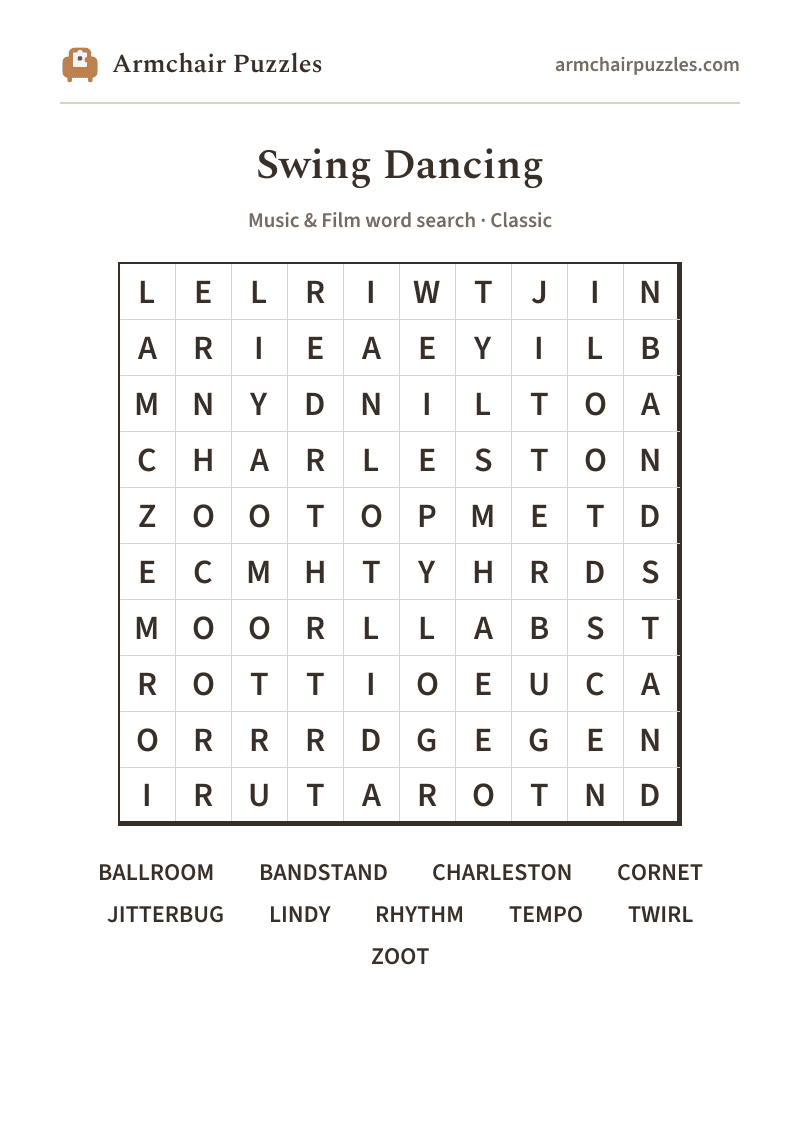
Prefer pen and paper?
A clean, large-print sheet. Free, and no sign-up.