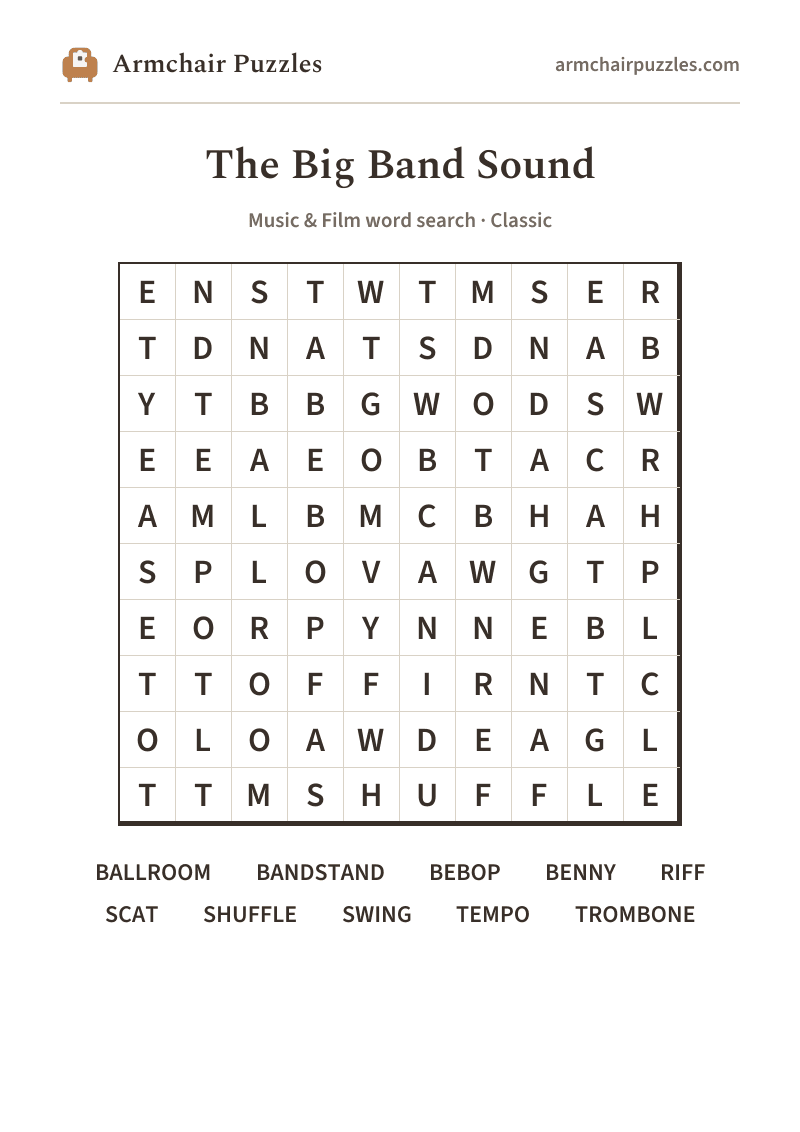
Word 1 of 10: BANDSTAND
Use the arrow keys to move between letters. Press Enter or Space on the first letter of a word, then again on the last letter. Press Escape to cancel.
A few of the words
- TROMBONE
- The trombone's slide gave big band arrangers a silky, gliding tone no valve instrument could quite match, Glenn Miller built his signature sound around it.Find this word in the grid to read its note.
- SCAT
- Scat singing, improvising with syllables instead of words, became a defining art of the swing era, with Ella Fitzgerald among its most celebrated voices.Find this word in the grid to read its note.
- BEBOP
- By the mid-1940s, younger jazz musicians began pushing into bebop, faster tempos and complex harmonies that grew directly out of the big band tradition.Find this word in the grid to read its note.
- BANDSTAND
- The raised bandstand gave the whole room a focal point; spotlights would catch the flash of a trumpet bell mid-solo, stopping dancers in their tracks.Find this word in the grid to read its note.
armchairpuzzles.com · free large-print word searches
big band word search
The Big Band Sound: a free online word search
Big band word search, free, no sign-up. Brass glinting under the ballroom lights, the bandleader's baton cutting the air. Prints clean, ready for a pen.
About The Big Band Sound
From the mid-1930s through the 1940s, big bands filled ballrooms from Harlem to Hollywood. Leaders like Glenn Miller, Benny Goodman, and Duke Ellington commanded ensembles of fifteen or more musicians, brass, reeds, and rhythm working in tight, thrilling unison. The dance floor was the true stage, and a single Friday night could put hundreds of couples in motion to the same rolling, irresistible beat.
How to play
- 1Find a word.Tap its first letter, then tap along to its last. The trail fills in and finishes itself when it spells a word. Or press the first letter and drag.
- 2Words run in straight lines.Across and down, and on the harder difficulties diagonally and backwards.
- 3It marks itself.Each word you find takes on its own soft color on the grid and is crossed off the list.
- 4Choose a difficulty.The level you pick sets those directions and how much the word list helps, never the grid size. Tap the A buttons at the top to enlarge the letters, or pinch the grid.
Prefer pen and paper?
A clean, large-print sheet. Free, and no sign-up.