Word 1 of 10: WIRELESS
Use the arrow keys to move between letters. Press Enter or Space on the first letter of a word, then again on the last letter. Press Escape to cancel.
A few of the words
- VIMY
- Their aircraft was a Vickers Vimy, a twin-engine biplane built as a heavy bomber in World War I and converted for the long Atlantic crossing.Find this word in the grid to read its note.
- CLIFDEN
- The journey ended not on a runway but in a soft bog near Clifden, on the west coast of Ireland, where the Vimy's nose tipped forward on landing.Find this word in the grid to read its note.
- WIRELESS
- Brown used a wireless telegraph set during the flight, though heavy icing and turbulence made reliable communication close to impossible over open ocean.Find this word in the grid to read its note.
- NEWFOUND
- Alcock and Brown departed from St. John's, Newfoundland, the easternmost point of North America and the shortest practical jumping-off point for Europe.Find this word in the grid to read its note.
armchairpuzzles.com · free large-print word searches
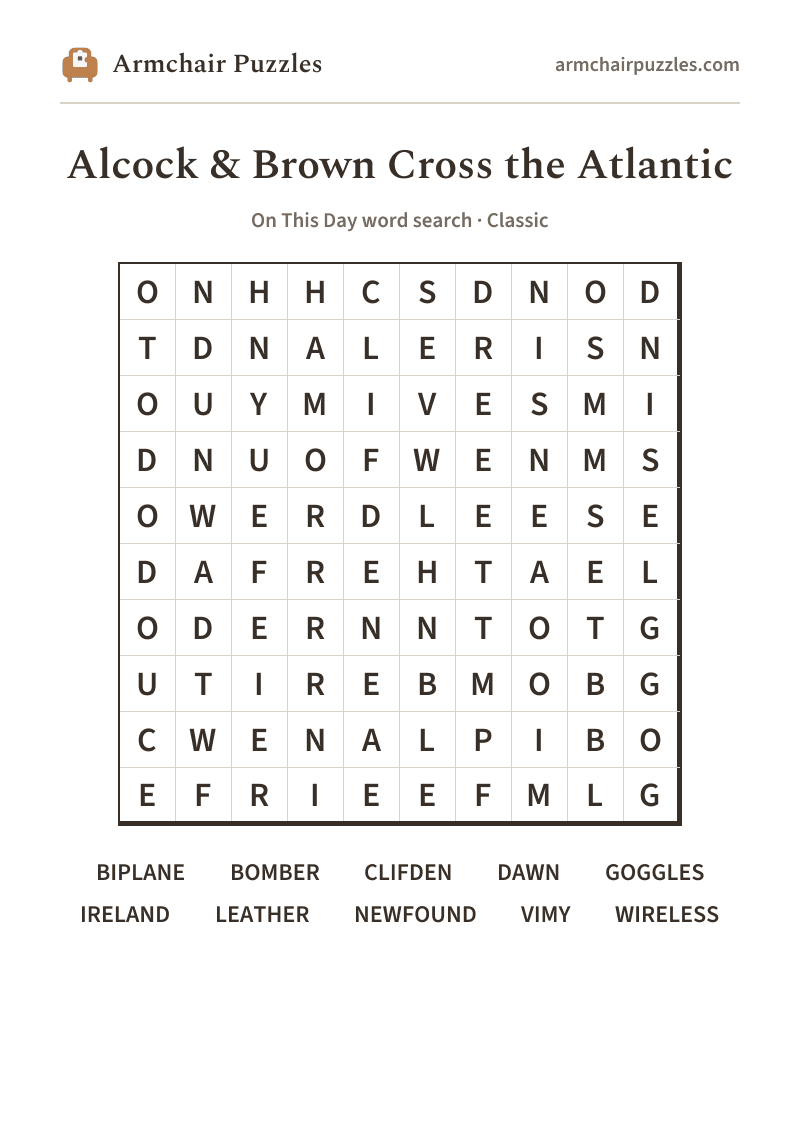
Alcock and Brown transatlantic flight word search
Alcock & Brown Cross the Atlantic: a free online word search
Alcock and Brown transatlantic flight word search, free with no sign-up, tracing their 16-hour crossing through fog and open sky.
About Alcock & Brown Cross the Atlantic
On June 14, 1919, John Alcock and Arthur Whitten Brown climbed into a modified Vickers Vimy bomber at St. John's, Newfoundland, and pointed its nose east across the Atlantic. Sixteen grinding hours later, through spinning fog banks, blinding sleet, and at least one terrifying spiral toward the ocean, they touched down in a bog near Clifden, Ireland, completing the first nonstop transatlantic crossing in history. They wore leather flying suits and relied on dead reckoning and a compass, coaxing a converted warplane across nearly 1,900 miles of open water with nothing but nerve and the pale light of dawn to guide them home.
How to play
- 1Find a word.Tap its first letter, then tap along to its last. The trail fills in and finishes itself when it spells a word. Or press the first letter and drag.
- 2Words run in straight lines.Across and down, and on the harder difficulties diagonally and backwards.
- 3It marks itself.Each word you find takes on its own soft color on the grid and is crossed off the list.
- 4Choose a difficulty.The level you pick sets those directions and how much the word list helps, never the grid size. Tap the A buttons at the top to enlarge the letters, or pinch the grid.
Prefer pen and paper?
A clean, large-print sheet. Free, and no sign-up.
More to explore:All On This Day word searchesPrintable On This Day word searches