Word 1 of 10: DIAMOND
Use the arrow keys to move between letters. Press Enter or Space on the first letter of a word, then again on the last letter. Press Escape to cancel.
A few of the words
- DIAMOND
- The classic diamond kite shape has been around since at least the 13th century, when kites arrived in Europe from Asia along trade routes.Find this word in the grid to read its note.
- REEL
- Keeping steady tension on the reel is the whole trick on a gusty day. Let it go slack and the kite stalls and tumbles.Find this word in the grid to read its note.
- TAIL
- The tail isn't just decoration. It adds drag to keep the kite stable, and most fliers add or remove length until the thing stops spinning.Find this word in the grid to read its note.
- CLIMB
- A kite doesn't climb in a straight line. It tugs and wanders, reading every shift in the wind before you can feel it yourself.Find this word in the grid to read its note.
armchairpuzzles.com · free large-print word searches
kite flying word search
Kite Flying: a free online word search
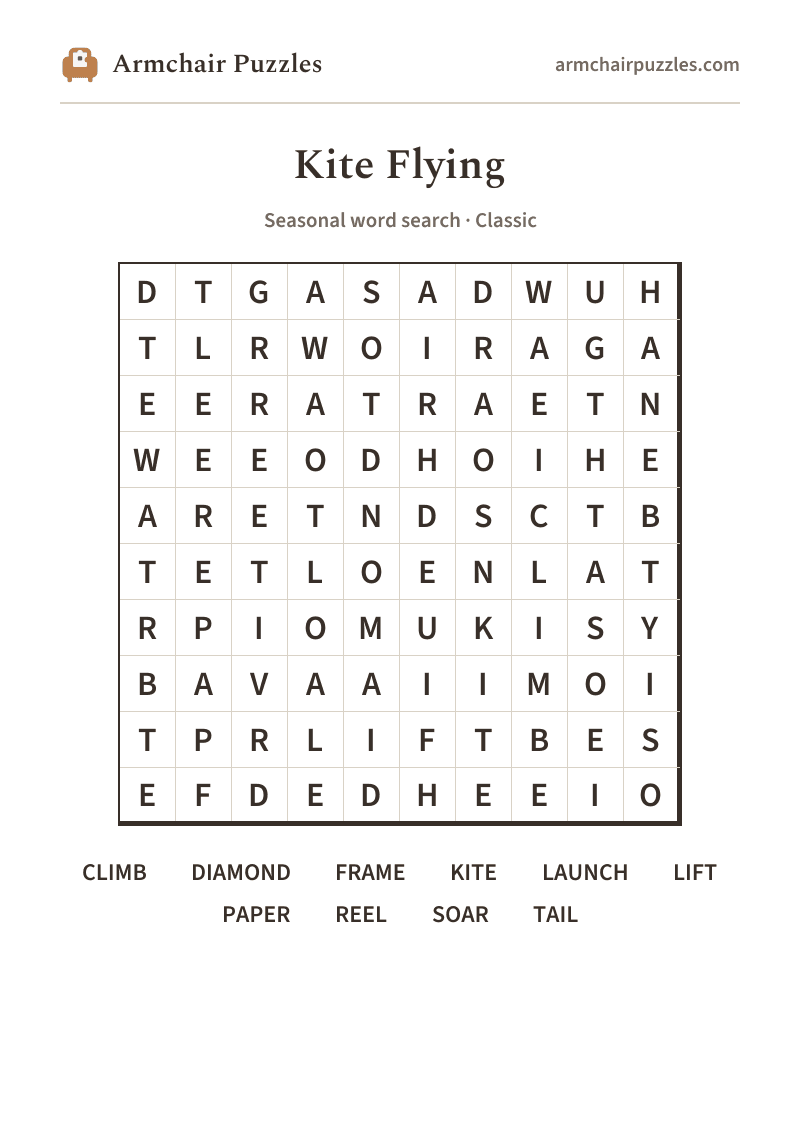
Kite flying word search, no account and nothing to install. March wind, a REEL of STRING, and all the sky you need.
About Kite Flying
A good kite day needs wind between 8 and 20 miles per hour, which is why March earns its reputation. The diamond shape most people picture goes back centuries, but Benjamin Franklin's famous 1752 experiment used a simpler square frame with a silk sail. Few things are quieter than standing in a field with the STRING humming faintly in your hand and the kite just a speck above.
How to play
- 1Find a word.Tap its first letter, then tap along to its last. The trail fills in and finishes itself when it spells a word. Or press the first letter and drag.
- 2Words run in straight lines.Across and down, and on the harder difficulties diagonally and backwards.
- 3It marks itself.Each word you find takes on its own soft color on the grid and is crossed off the list.
- 4Choose a difficulty.The level you pick sets those directions and how much the word list helps, never the grid size. Tap the A buttons at the top to enlarge the letters, or pinch the grid.
Prefer pen and paper?
A clean, large-print sheet. Free, and no sign-up.
More to explore:All Seasonal word searchesPrintable Seasonal word searches