Word 1 of 10: SPECKLED
Use the arrow keys to move between letters. Press Enter or Space on the first letter of a word, then again on the last letter. Press Escape to cancel.
A few of the words
- BLUE
- Robin eggs get their color from a pigment called biliverdin, deposited as the egg moves through the mother's body. The shade is consistent enough that 'robin's egg blue' has been a named paint and fabric color since at least the 1800s.Find this word in the grid to read its note.
- CLUTCH
- A single clutch usually holds 3 to 5 eggs, and a pair of robins can raise two or even three clutches in a single season between April and July.Find this word in the grid to read its note.
- WARBLE
- The robin's song is a rolling, fluty warble that rises and falls in short phrases. Birders often describe it as the sound that officially opens the morning, since robins typically begin singing a full hour before other songbirds join in.Find this word in the grid to read its note.
- FLEDGE
- Young robins fledge, meaning they leave the nest, just 13 days after hatching. They can't fly well yet, so you'll often find them hopping on the ground while a parent keeps close watch nearby.Find this word in the grid to read its note.
armchairpuzzles.com · free large-print word searches
robins return word search
Robins Return: a free online word search
Robins return word search, playable online the moment you open it. Spot the blue egg tucked in the grid before you hear that first dawn song.
About Robins Return
The American robin is often the first bird people notice after a long winter, and for good reason. A male will stake out his territory and start singing before sunrise, sometimes as early as late February, even when there's still frost on the grass. The female builds the nest almost entirely on her own, weaving together twigs and mud into a tight cup and lining it with fine grasses before she lays those famously blue eggs.
How to play
- 1Find a word.Tap its first letter, then tap along to its last. The trail fills in and finishes itself when it spells a word. Or press the first letter and drag.
- 2Words run in straight lines.Across and down, and on the harder difficulties diagonally and backwards.
- 3It marks itself.Each word you find takes on its own soft color on the grid and is crossed off the list.
- 4Choose a difficulty.The level you pick sets those directions and how much the word list helps, never the grid size. Tap the A buttons at the top to enlarge the letters, or pinch the grid.
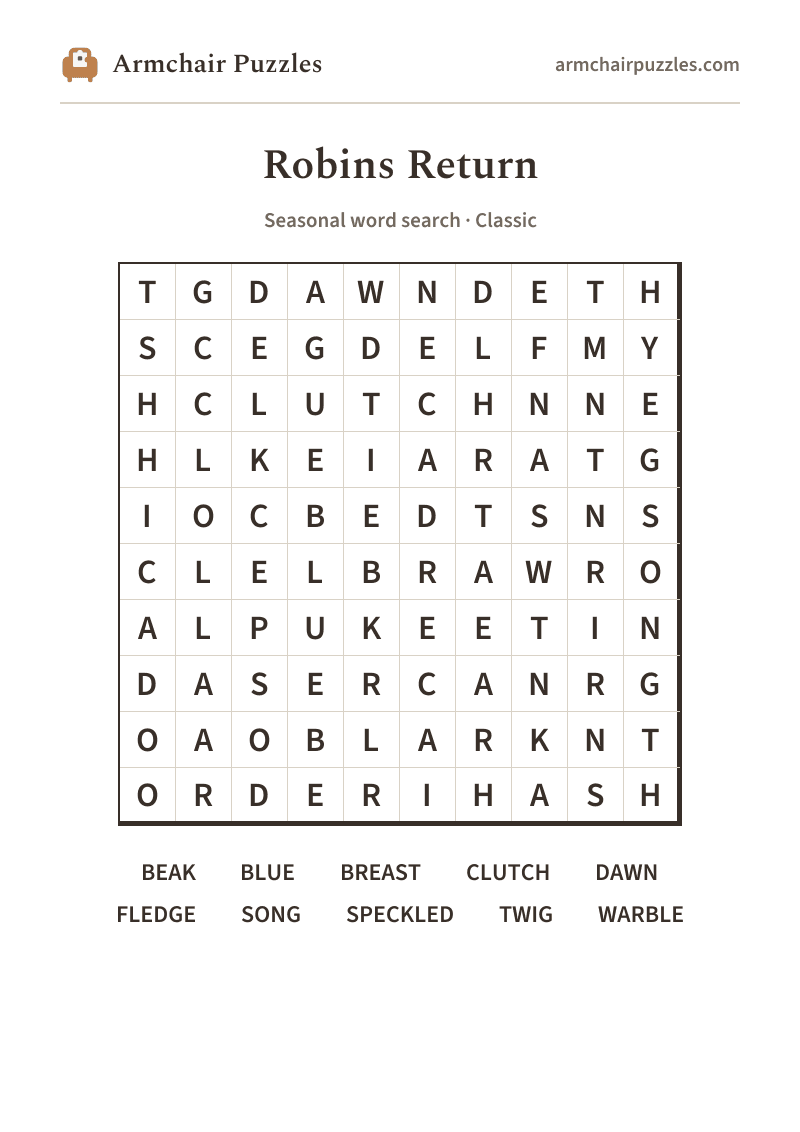
Prefer pen and paper?
A clean, large-print sheet. Free, and no sign-up.
More to explore:All Seasonal word searchesPrintable Seasonal word searches