Use the arrow keys to move between letters. Press Enter or Space on the first letter of a word, then again on the last letter. Press Escape to cancel.
A few of the words
- DECODE
- Jean-François Champollion cracked the hieroglyphic code in 1822, building on the Stone's trilingual inscription to produce the first working decipherment of ancient Egyptian script.Find this word in the grid to read its note.
- DEMOTIC
- Demotic was the everyday cursive script of ancient Egypt, the Stone's middle text, and proved a vital bridge between the Greek scholars could read and the hieroglyphs they could not.Find this word in the grid to read its note.
- PTOLEMY
- The decree on the Stone was issued in 196 BCE to honor the young pharaoh Ptolemy V, granting tax exemptions and honors to the priesthood throughout Egypt.Find this word in the grid to read its note.
- STELE
- The Rosetta Stone is technically a stele, an upright stone slab used in the ancient world to display official proclamations, laws, or commemorations for public view.Find this word in the grid to read its note.
armchairpuzzles.com · free large-print word searches
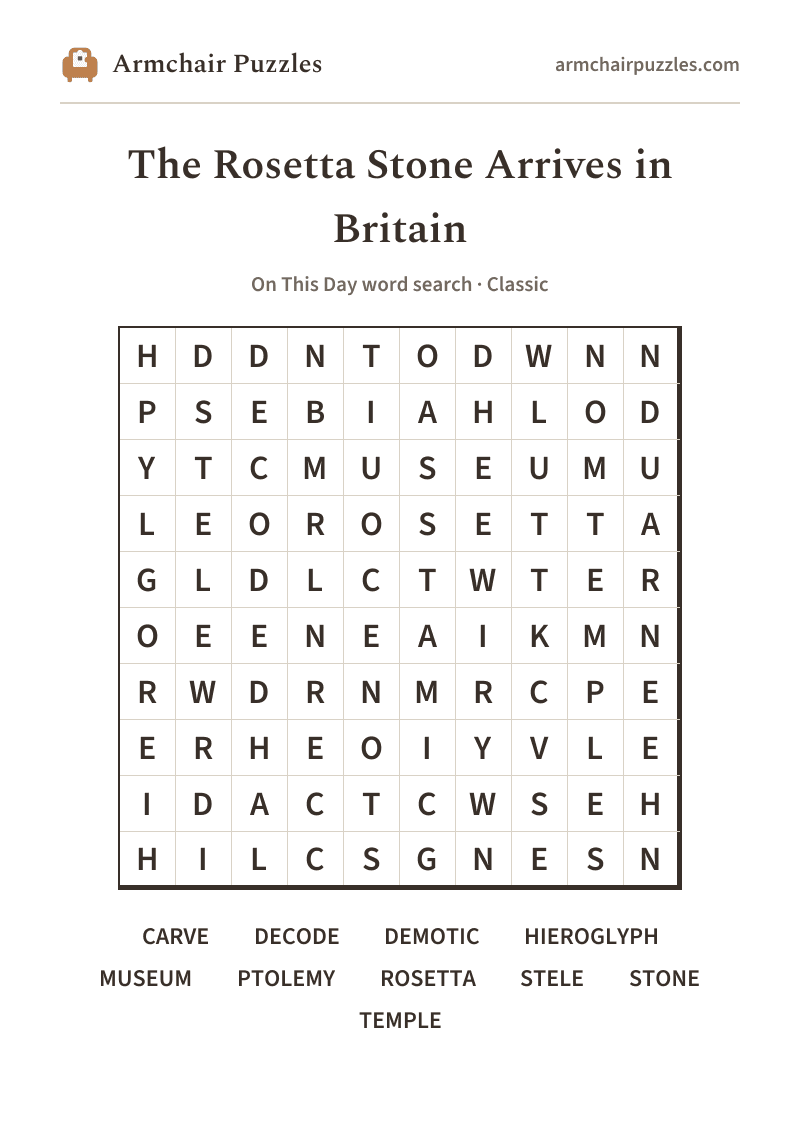
Rosetta Stone word search
The Rosetta Stone Arrives in Britain: a free online word search
Rosetta Stone word search, free, covering the 196 BC decree that cracked hieroglyphics open for scholars after fourteen silent centuries.
About The Rosetta Stone Arrives in Britain
On July 8, 1802, the Rosetta Stone arrived in Britain and was delivered to the British Museum in London, where it has remained ever since. The dark granodiorite slab, carved in 196 BCE by order of Ptolemy V, carries the same priestly decree written in three scripts: hieroglyphic, Demotic, and Greek. That triple inscription handed scholars the clue they needed to crack a language silent for centuries, opening an entire civilization to the modern world.
How to play
- 1Find a word.Tap its first letter, then tap along to its last. The trail fills in and finishes itself when it spells a word. Or press the first letter and drag.
- 2Words run in straight lines.Across and down, and on the harder difficulties diagonally and backwards.
- 3It marks itself.Each word you find takes on its own soft color on the grid and is crossed off the list.
- 4Choose a difficulty.Relaxed, Classic or Challenging set those directions and how much the word list helps, never the grid size. Tap the A buttons at the top to enlarge the letters, or pinch the grid.
Prefer pen and paper?
A clean, large-print sheet. Free, and no sign-up.
More to explore:All On This Day word searchesPrintable On This Day word searches