Word 1 of 10: CHEMISTRY
Use the arrow keys to move between letters. Press Enter or Space on the first letter of a word, then again on the last letter. Press Escape to cancel.
A few of the words
- POLONIUM
- Marie named this element after Poland, the country of her birth, a quiet act of patriotism embedded in the periodic table forever.Find this word in the grid to read its note.
- RADIUM
- Radium was so intensely radioactive that samples in the Curies' lab glowed faintly blue-green in the dark, a sight Marie described as 'fairy lights.'Find this word in the grid to read its note.
- MEDALS
- Among Marie's honors was the Davy Medal, awarded to her and Pierre jointly in 1903, one of the Royal Society's most prestigious prizes.Find this word in the grid to read its note.
armchairpuzzles.com · free large-print word searches
Marie Curie word search
Marie Curie's Nobel Prize: The Scientist Who Changed Everything: a free online word search
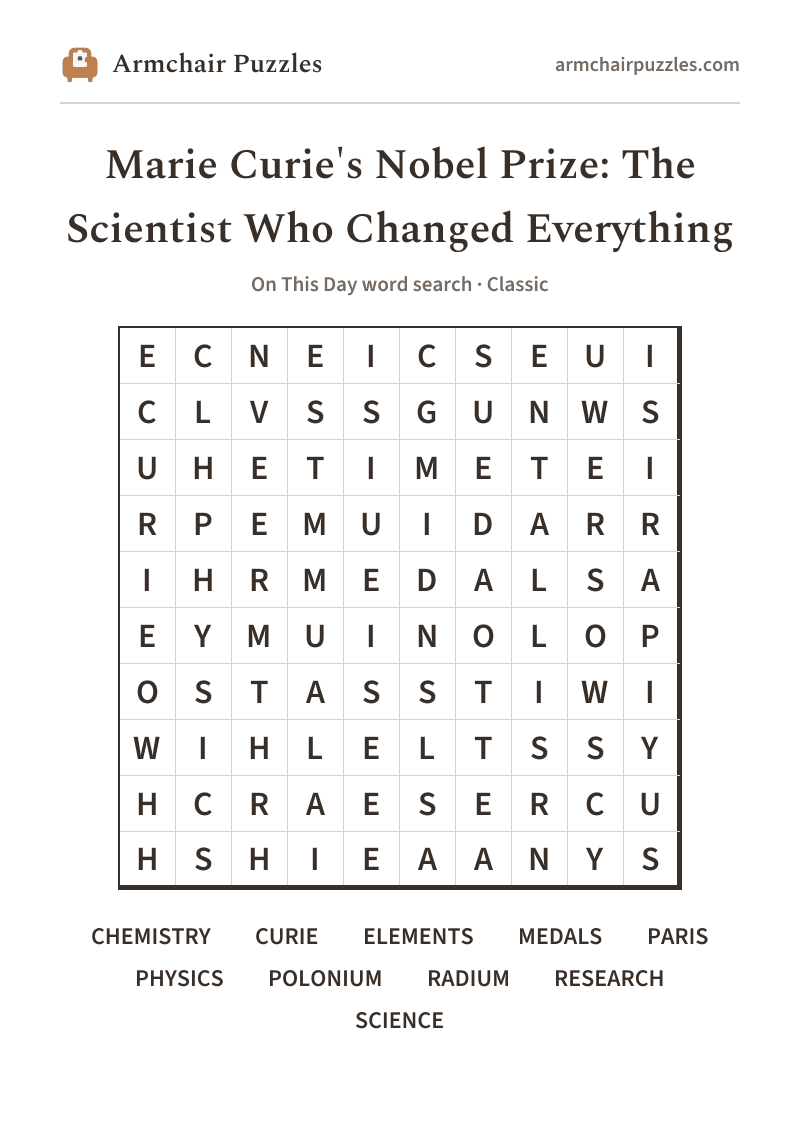
Marie Curie word search, no account and nothing to install. Polonium, radium, and the two Nobel Prizes she earned before most universities would admit women.
About Marie Curie's Nobel Prize: The Scientist Who Changed Everything
On November 7, 1867, Marie Sklodowska was born in Warsaw, Poland, and the world of science would never be the same. She moved to Paris, earned degrees no woman had held before, and in her humble laboratory she and her husband Pierre isolated two new elements: polonium, named for her homeland, and radium, which glowed with a ghostly blue light. She became the first person to win two Nobel Prizes, one in Physics in 1903 and one in Chemistry in 1911, opening a door that generations of researchers have walked through ever since.
How to play
- 1Find a word.Tap its first letter, then tap along to its last. The trail fills in and finishes itself when it spells a word. Or press the first letter and drag.
- 2Words run in straight lines.Across and down, and on the harder difficulties diagonally and backwards.
- 3It marks itself.Each word you find takes on its own soft color on the grid and is crossed off the list.
- 4Choose a difficulty.The level you pick sets those directions and how much the word list helps, never the grid size. Tap the A buttons at the top to enlarge the letters, or pinch the grid.
Prefer pen and paper?
A clean, large-print sheet. Free, and no sign-up.
More to explore:All On This Day word searchesPrintable On This Day word searches
Also on Armchair Puzzles:Free word search games for seniorsToday’s daily word search