Use the arrow keys to move between letters. Press Enter or Space on the first letter of a word, then again on the last letter. Press Escape to cancel.
A few of the words
- PLATE
- Jennings used a glass photographic plate coated with a light-sensitive emulsion, the standard medium for serious photography in 1882, long before flexible film became common.Find this word in the grid to read its note.
- BRANCH
- The photograph's great revelation was the branching, tree-like structure of the bolt, a geometry invisible to the unaided eye in the fraction of a second lightning lasts.Find this word in the grid to read its note.
- ELECTRIC
- Lightning is a massive electrostatic discharge, with a single bolt carrying hundreds of millions of volts, a force Jennings could now show the world in frozen detail.Find this word in the grid to read its note.
- CAPTURE
- Jennings's achievement in Philadelphia on July 9, 1882 proved that the camera could do what no human eye could: capture and hold a single, fleeting bolt of lightning.Find this word in the grid to read its note.
armchairpuzzles.com · free large-print word searches
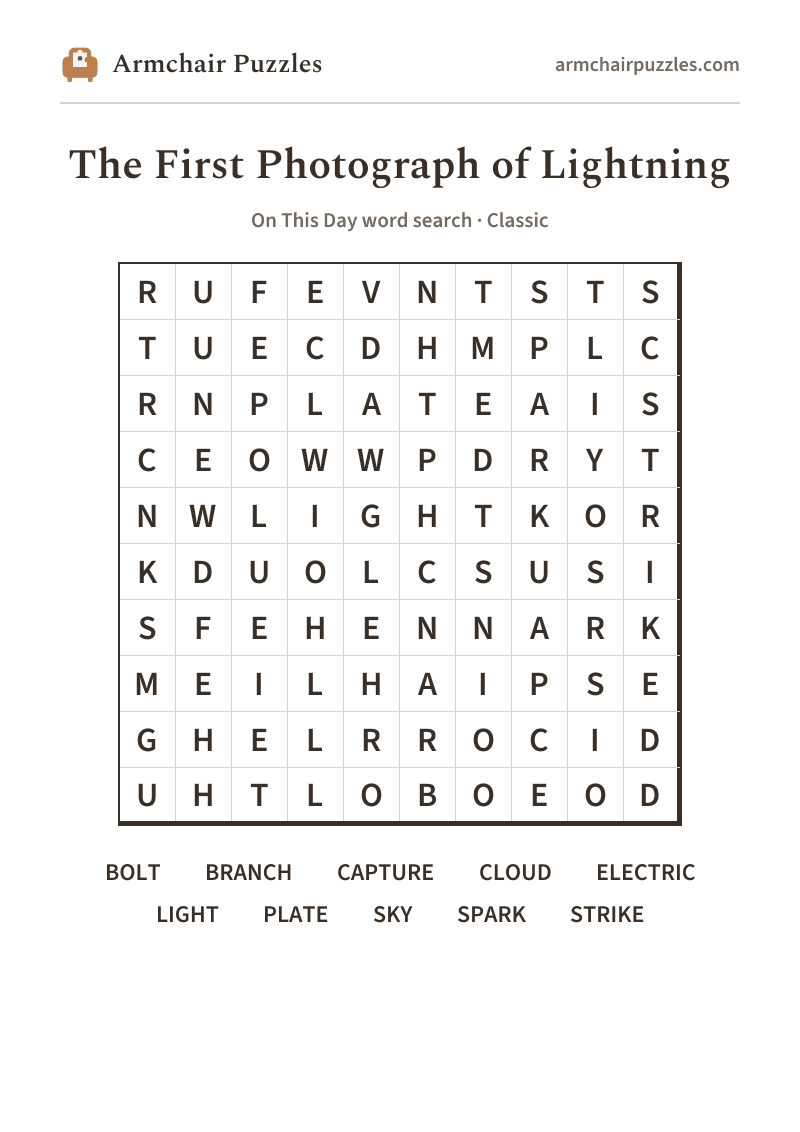
first photograph of lightning word search
The First Photograph of Lightning: a free online word search
First photograph of lightning word search: in 1882, William Jennings caught a Philadelphia bolt on film, every jagged branch its own shape.
About The First Photograph of Lightning
On July 9, 1882, amateur astronomer William Nicholson Jennings pointed his camera at a stormy Philadelphia sky and made history, capturing the first successful photograph of a lightning bolt. Before that night, the branching, jagged structure of a lightning strike existed only as a blur in living memory, gone before the eye could truly study it. Jennings's glass plate held the bolt still at last, turning a wild electric moment into something the world could finally see, measure, and marvel at.
How to play
- 1Find a word.Tap its first letter, then tap along to its last. The trail fills in and finishes itself when it spells a word. Or press the first letter and drag.
- 2Words run in straight lines.Across and down, and on the harder difficulties diagonally and backwards.
- 3It marks itself.Each word you find takes on its own soft color on the grid and is crossed off the list.
- 4Choose a difficulty.Relaxed, Classic or Challenging set those directions and how much the word list helps, never the grid size. Tap the A buttons at the top to enlarge the letters, or pinch the grid.
Prefer pen and paper?
A clean, large-print sheet. Free, and no sign-up.
More to explore:All On This Day word searchesPrintable On This Day word searches