Use the arrow keys to move between letters. Press Enter or Space on the first letter of a word, then again on the last letter. Press Escape to cancel.
A few of the words
- WEBSTER
- Noah Webster spent decades reading, writing, and revising before his landmark 1806 publication, and went on to publish the even larger 'American Dictionary of the English Language' in 1828.Find this word in the grid to read its note.
- SPELLING
- Webster deliberately simplified dozens of spellings, dropping the 'u' from words like 'color' and the 'k' from 'musick', to give American English a cleaner, more logical look on the page.Find this word in the grid to read its note.
- LEXICON
- The word 'lexicon' traces back to the ancient Greek 'lexikon,' meaning 'of words', a fitting ancestor for the book Webster devoted his life to building.Find this word in the grid to read its note.
- PRESS
- Webster's 1806 dictionary rolled off a printing press at a time when hand-set type was still the standard, each letter placed one by one before the ink ever touched the page.Find this word in the grid to read its note.
armchairpuzzles.com · free large-print word searches
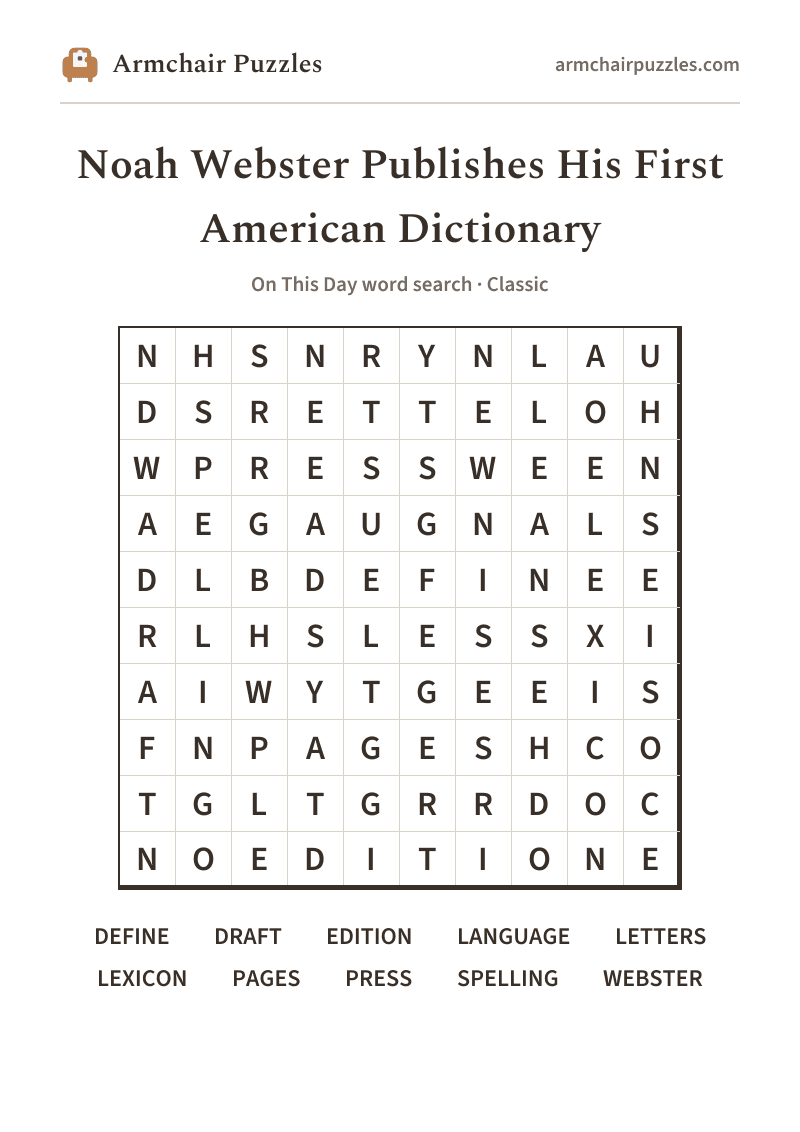
Noah Webster dictionary word search
Noah Webster Publishes His First American Dictionary: a free online word search
Noah Webster's 1806 dictionary named American English on its own terms. This word search puts you inside that world.
About Noah Webster Publishes His First American Dictionary
On October 16, 1806, Noah Webster published "A Compendious Dictionary of the English Language", the first dictionary built expressly for American readers. It introduced simplified spellings like "color" and "music," cutting away letters Webster considered unnecessary, and added words born on American soil: words for native plants, frontier tools, and the new republic's civic life. Every entry was a small act of independence, a declaration that American English deserved its own authoritative voice on the page.
How to play
- 1Find a word.Tap its first letter, then tap along to its last. The trail fills in and finishes itself when it spells a word. Or press the first letter and drag.
- 2Words run in straight lines.Across and down, and on the harder difficulties diagonally and backwards.
- 3It marks itself.Each word you find takes on its own soft color on the grid and is crossed off the list.
- 4Choose a difficulty.The level you pick sets those directions and how much the word list helps, never the grid size. Tap the A buttons at the top to enlarge the letters, or pinch the grid.
Prefer pen and paper?
A clean, large-print sheet. Free, and no sign-up.
More to explore:All On This Day word searchesPrintable On This Day word searches