Use the arrow keys to move between letters. Press Enter or Space on the first letter of a word, then again on the last letter. Press Escape to cancel.
A few of the words
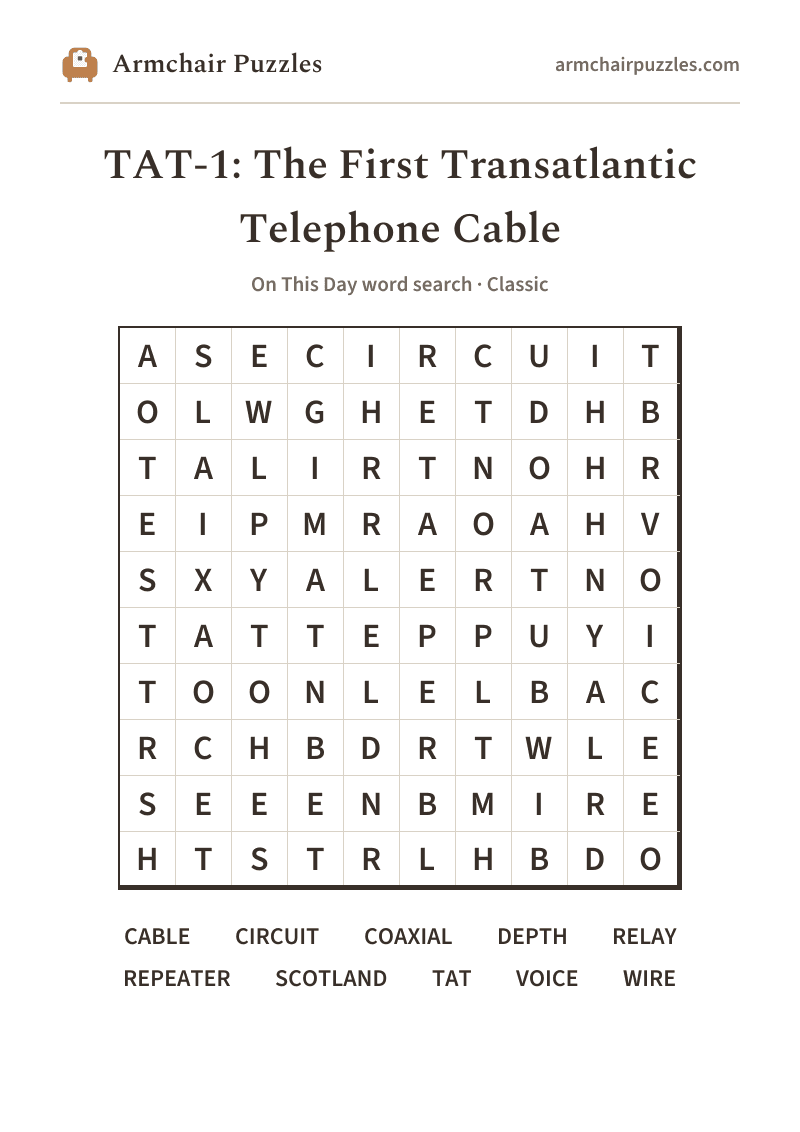
- REPEATER
- TAT-1 carried 51 vacuum-tube repeater amplifiers embedded along its length, each one boosting the signal before it could fade in the depths.Find this word in the grid to read its note.
- SCOTLAND
- The European end of TAT-1 came ashore at Gallanach Bay, near Oban on the west coast of Scotland, chosen for its sheltered approach from the open Atlantic.Find this word in the grid to read its note.
- COAXIAL
- TAT-1 used a coaxial design, a central copper conductor wrapped in insulating polyethylene and then shielded by steel armor, purpose-built to survive deep-sea pressure.Find this word in the grid to read its note.
- TAT
- TAT stands for Trans-Atlantic Telephone; TAT-1 could carry 36 simultaneous voice calls, a staggering leap over the handful of radio-telephone circuits it replaced.Find this word in the grid to read its note.
armchairpuzzles.com · free large-print word searches
TAT-1 transatlantic telephone cable word search
TAT-1: The First Transatlantic Telephone Cable: a free online word search
TAT-1 transatlantic telephone cable word search. September 25, 1956: a voice crossed the Atlantic on copper wire for the first time. NEWFOUNDLAND is in there.
About TAT-1: The First Transatlantic Telephone Cable
On September 25, 1956, TAT-1, the first transatlantic telephone cable, opened for commercial service, linking Gallanach Bay in Scotland to Clarenville, Newfoundland across nearly 4,000 miles of Atlantic Ocean floor. Before that day, a transatlantic phone call meant routing through fragile radio waves that crackled with static and faded with the weather; suddenly, a voice could travel clear and steady through the cold dark deep. The cable was a marvel of coaxial design, wound with copper conductors and studded with repeater amplifiers every forty miles or so to keep the signal alive for its entire underwater journey.
How to play
- 1Find a word.Tap its first letter, then tap along to its last. The trail fills in and finishes itself when it spells a word. Or press the first letter and drag.
- 2Words run in straight lines.Across and down, and on the harder difficulties diagonally and backwards.
- 3It marks itself.Each word you find takes on its own soft colour on the grid and is crossed off the list.
- 4Choose a difficulty.Relaxed, Classic or Challenging set those directions and how much the word list helps, never the grid size. Tap the A buttons at the top to enlarge the letters, or pinch the grid.
Prefer pen and paper?
A clean, large-print sheet. Free, and no sign-up.
More to explore:All On This Day word searchesPrintable On This Day word searches
↑ Back to the puzzle