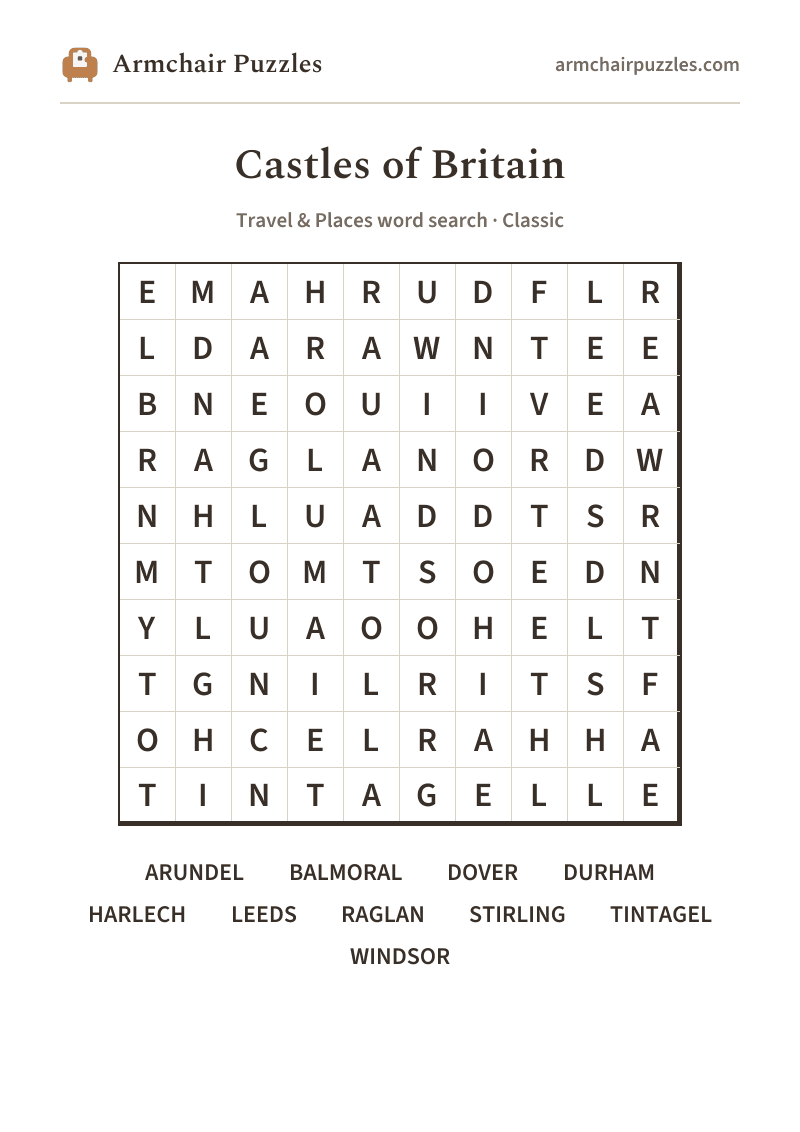
Word 1 of 10: BALMORAL
Use the arrow keys to move between letters. Press Enter or Space on the first letter of a word, then again on the last letter. Press Escape to cancel.
A few of the words
- WINDSOR
- Windsor is the oldest and largest inhabited castle in the world, begun by William the Conqueror not long after 1066.Find this word in the grid to read its note.
- BALMORAL
- Queen Victoria and Prince Albert bought the Balmoral estate in Aberdeenshire in 1852, and the royal family has holidayed there ever since.Find this word in the grid to read its note.
- DOVER
- Dover Castle sits above the shortest sea crossing to France, and was called the Key to England for good reason.Find this word in the grid to read its note.
- TINTAGEL
- Tintagel's ruins on the Cornish coast are tied by legend to King Arthur, though the stonework itself dates from the 1230s.Find this word in the grid to read its note.
armchairpuzzles.com · free large-print word searches
castles of britain word search
Castles of Britain: a free online word search
Castles of Britain word search, free and printable, from Windsor's round tower to the wind-bitten ruins on the Cornish and Northumbrian coast.
About Castles of Britain
Britain has more castles than most people could visit in a lifetime, and they run from Norman keeps to Edward I's ring of Welsh fortresses to Victorian Highland retreats. Some are still lived in, some are lawns and broken walls with sheep grazing nearby. Stand on any of them on a gray afternoon and you can almost hear the wind working through the arrow slits.
How to play
- 1Find a word.Tap its first letter, then tap along to its last. The trail fills in and finishes itself when it spells a word. Or press the first letter and drag.
- 2Words run in straight lines.Across and down, and on the harder difficulties diagonally and backwards.
- 3It marks itself.Each word you find takes on its own soft color on the grid and is crossed off the list.
- 4Choose a difficulty.The level you pick sets those directions and how much the word list helps, never the grid size. Tap the A buttons at the top to enlarge the letters, or pinch the grid.
Prefer pen and paper?
A clean, large-print sheet. Free, and no sign-up.