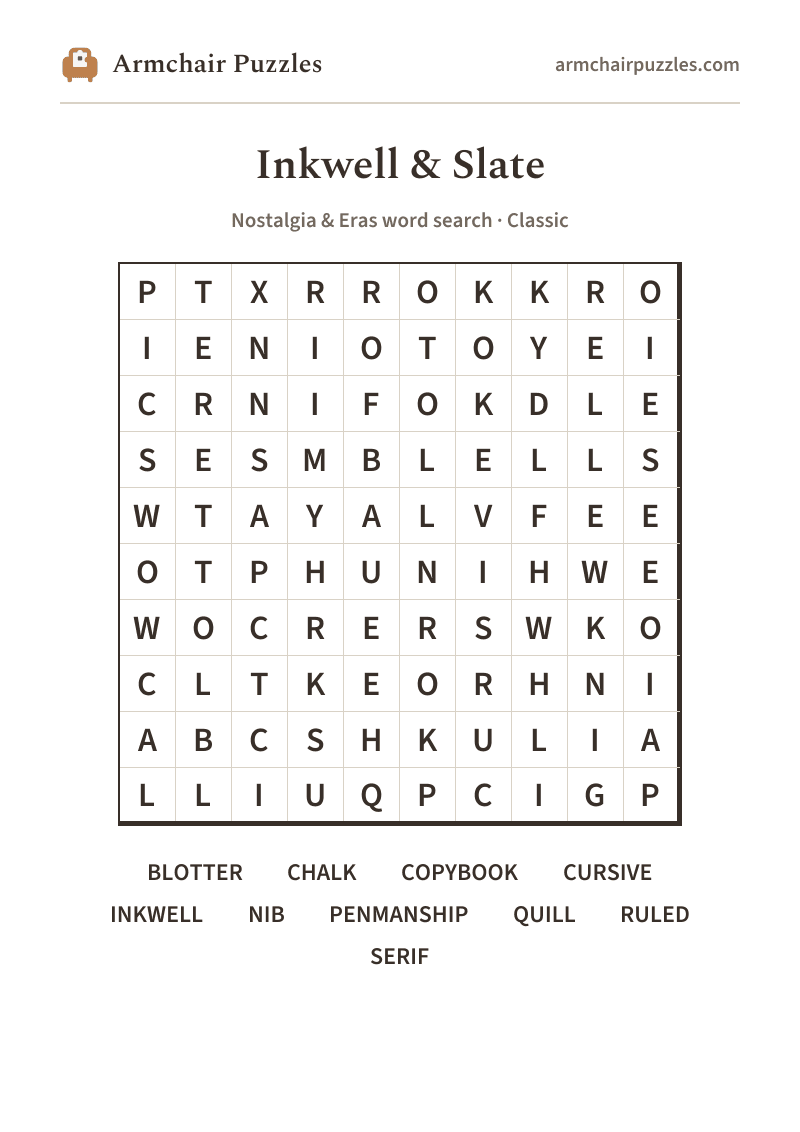
Use the arrow keys to move between letters. Press Enter or Space on the first letter of a word, then again on the last letter. Press Escape to cancel.
A few of the words
- INKWELL
- Desks in 19th- and early 20th-century schoolrooms were often fitted with a small round hole near the top right corner, sized precisely to cradle a ceramic inkwell within easy dipping reach.Find this word in the grid to read its note.
- NIB
- A steel nib's split tip created just enough flex to vary line thickness with pressure, a light touch produced a thin upstroke, while pressing down on the downstroke gave the letter its characteristic weight.Find this word in the grid to read its note.
- COPYBOOK
- The phrase 'blotting your copybook', meaning to spoil your reputation, comes directly from the schoolroom: a stray ink drop on a copybook's model page was a visible, lasting mark against your care and character.Find this word in the grid to read its note.
- CURSIVE
- Connected cursive script was prized not just for elegance but for speed, lifting the pen repeatedly between letters slowed the hand, and a flowing joined style let a practiced writer keep pace with a teacher's dictation.Find this word in the grid to read its note.
armchairpuzzles.com · free large-print word searches
inkwell and slate word search
Inkwell & Slate: a free online word search
Inkwell and slate word search, back when a fountain pen and good penmanship were the whole point. Prints clean, one sheet, ready for a real pen.
About Inkwell & Slate
Before the ballpoint arrived on every desk, a student's morning began with uncapping the inkwell and selecting a nib, and every stroke had to be deliberate. Penmanship was a subject in itself: the copybook set the ideal letterform and the student traced it, again and again, until the loop of each cursive letter came naturally. A blotter stood by to press away the excess, and a wet sponge wiped the slate clean for the next lesson, leaving nothing behind but the faint smell of chalk dust in the air.
How to play
- 1Find a word.Tap its first letter, then tap along to its last. The trail fills in and finishes itself when it spells a word. Or press the first letter and drag.
- 2Words run in straight lines.Across and down, and on the harder difficulties diagonally and backwards.
- 3It marks itself.Each word you find takes on its own soft color on the grid and is crossed off the list.
- 4Choose a difficulty.The level you pick sets those directions and how much the word list helps, never the grid size. Tap the A buttons at the top to enlarge the letters, or pinch the grid.
Prefer pen and paper?
A clean, large-print sheet. Free, and no sign-up.