Word 1 of 10: SPECTRUM
Use the arrow keys to move between letters. Press Enter or Space on the first letter of a word, then again on the last letter. Press Escape to cancel.
A few of the words
- SPECTRUM
- The ZX Spectrum launched in April 1982 at just £125, bringing colour graphics and a rubber keyboard into hundreds of thousands of British homes.Find this word in the grid to read its note.
- CASSETTE
- Games were stored on ordinary audio cassettes, the same kind you'd use for a mixtape, and loading one could take a nerve-shredding five minutes or more.Find this word in the grid to read its note.
- SINCLAIR
- Sir Clive Sinclair's Cambridge-based company sold over five million Spectrum units, making it the best-selling British home computer of its era.Find this word in the grid to read its note.
- ACORN
- Acorn's BBC Micro, introduced in 1981, was selected by the BBC Computer Literacy Project and found its way into almost every school in Britain.Find this word in the grid to read its note.
armchairpuzzles.com · free large-print word searches
home computers word search
Home Computers: a free online word search
Home computers word search, completely free. The ZX Spectrum's rubber keys, the Commodore 64's tape deck hiss. Some sounds you never quite forget.
About Home Computers
In the early 1980s, home computing arrived not in offices but in living rooms, balanced on coffee tables, plugged into the family television. A cassette would squeal and warble for two tense minutes before a game burst onto screen in blocky, brilliant colour. Machines like the ZX Spectrum and Commodore 64 didn't just entertain; they quietly handed a generation its first glimpse of what a computer could do.
How to play
- 1Find a word.Tap its first letter, then tap along to its last. The trail fills in and finishes itself when it spells a word. Or press the first letter and drag.
- 2Words run in straight lines.Across and down, and on the harder difficulties diagonally and backwards.
- 3It marks itself.Each word you find takes on its own soft color on the grid and is crossed off the list.
- 4Choose a difficulty.The level you pick sets those directions and how much the word list helps, never the grid size. Tap the A buttons at the top to enlarge the letters, or pinch the grid.
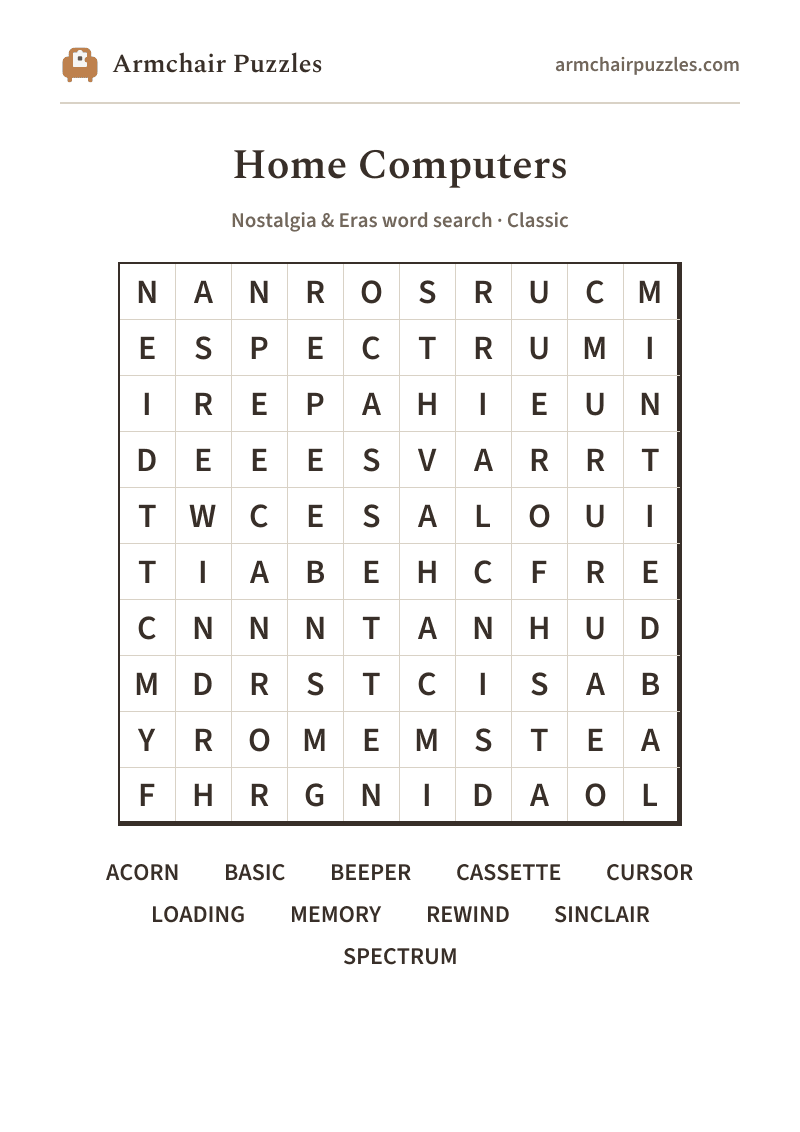
Prefer pen and paper?
A clean, large-print sheet. Free, and no sign-up.