Use the arrow keys to move between letters. Press Enter or Space on the first letter of a word, then again on the last letter. Press Escape to cancel.
A few of the words
- GODDARD
- Robert H. Goddard was awarded the first Smithsonian grant on September 27, 1917, a pivotal moment that funded his earliest rocket experiments.Find this word in the grid to read its note.
- SMITHSON
- The Smithsonian Institution, founded with a bequest from James Smithson, became Goddard's earliest and most important institutional backer.Find this word in the grid to read its note.
- NOZZLE
- Goddard understood that a precisely shaped nozzle, converting hot expanding gases into directed thrust, was the heart of an efficient rocket.Find this word in the grid to read its note.
- VACUUM
- Critics doubted a rocket could work in the vacuum of space; Goddard's physics proved that thrust needs no surrounding air to push against.Find this word in the grid to read its note.
armchairpuzzles.com · free large-print word searches
Robert Goddard Smithsonian grant word search
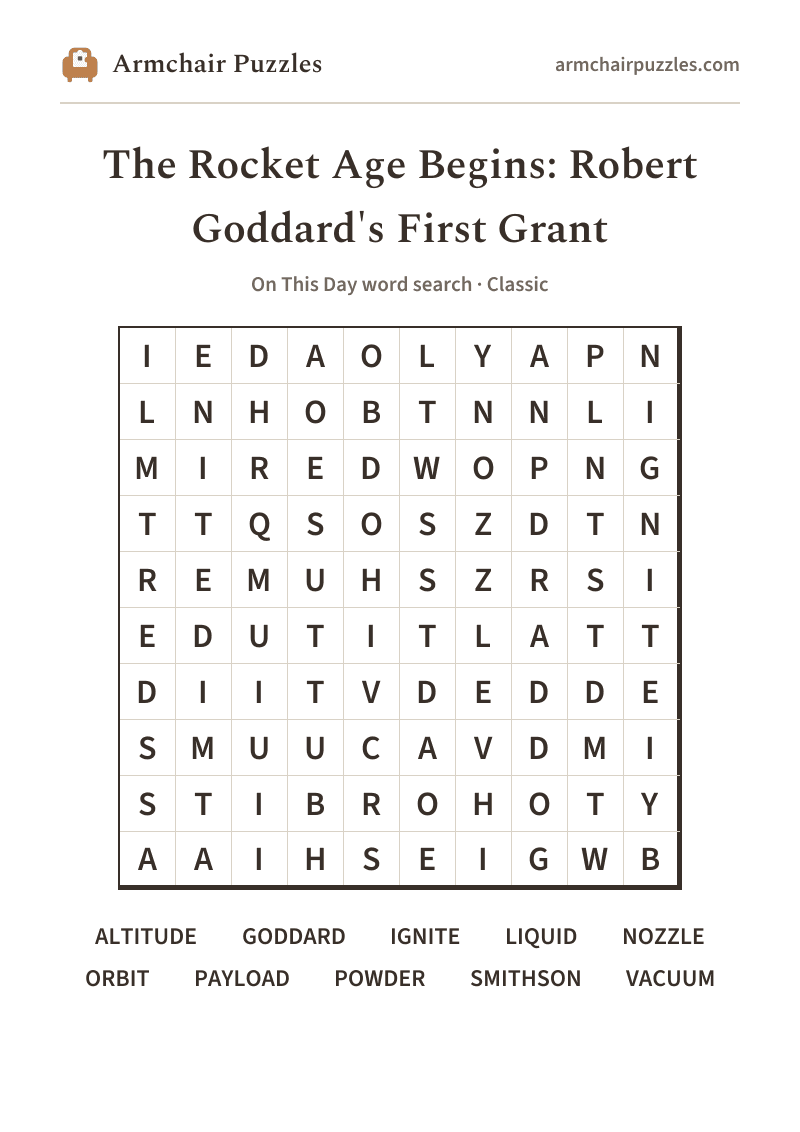
The Rocket Age Begins: Robert Goddard's First Grant: a free online word search
Robert Goddard's Smithsonian grant word search, playable online right now, marking September 27, 1917, the day rocket science got its first check.
About The Rocket Age Begins: Robert Goddard's First Grant
On September 27, 1917, Robert H. Goddard received his first grant from the Smithsonian Institution, $5,000 to pursue his radical vision of high-altitude rockets, an award that transformed a lone inventor's notebooks into serious experimental science. Goddard worked in quiet, painstaking solitude, testing combustion chambers, nozzle shapes, and propellants in his Massachusetts workshop, convinced that a rocket could function where there was no air to push against. That singular faith in the vacuum of space, backed at last by institutional funding, set humanity on the long arc toward the Moon and beyond.
How to play
- 1Find a word.Tap its first letter, then tap along to its last. The trail fills in and finishes itself when it spells a word. Or press the first letter and drag.
- 2Words run in straight lines.Across and down, and on the harder difficulties diagonally and backwards.
- 3It marks itself.Each word you find takes on its own soft color on the grid and is crossed off the list.
- 4Choose a difficulty.Relaxed, Classic or Challenging set those directions and how much the word list helps, never the grid size. Tap the A buttons at the top to enlarge the letters, or pinch the grid.
Prefer pen and paper?
A clean, large-print sheet. Free, and no sign-up.
More to explore:All On This Day word searchesPrintable On This Day word searches