Word 1 of 10: PETRICHOR
Use the arrow keys to move between letters. Press Enter or Space on the first letter of a word, then again on the last letter. Press Escape to cancel.
A few of the words
- UMBRELLA
- The word comes from the Italian 'ombrella,' meaning shade from the sun. It took a few centuries and a lot of rain for Americans and Europeans alike to fully repurpose it for wet weather.Find this word in the grid to read its note.
- PETRICHOR
- Isabel Joy Bear and Richard Thomas named this smell in a 1964 paper in the journal Nature. It comes mainly from a compound called geosmin, released by soil bacteria when rain hits dry ground.Find this word in the grid to read its note.
- RAINBOW
- A rainbow is always opposite the sun, so you'll never see one at midday in summer when the sun is high. Early morning and late afternoon are your best chances.Find this word in the grid to read its note.
- DRIZZLE
- Meteorologists define drizzle as droplets smaller than 0.5 millimeters across. Anything bigger officially counts as rain.Find this word in the grid to read its note.
armchairpuzzles.com · free large-print word searches
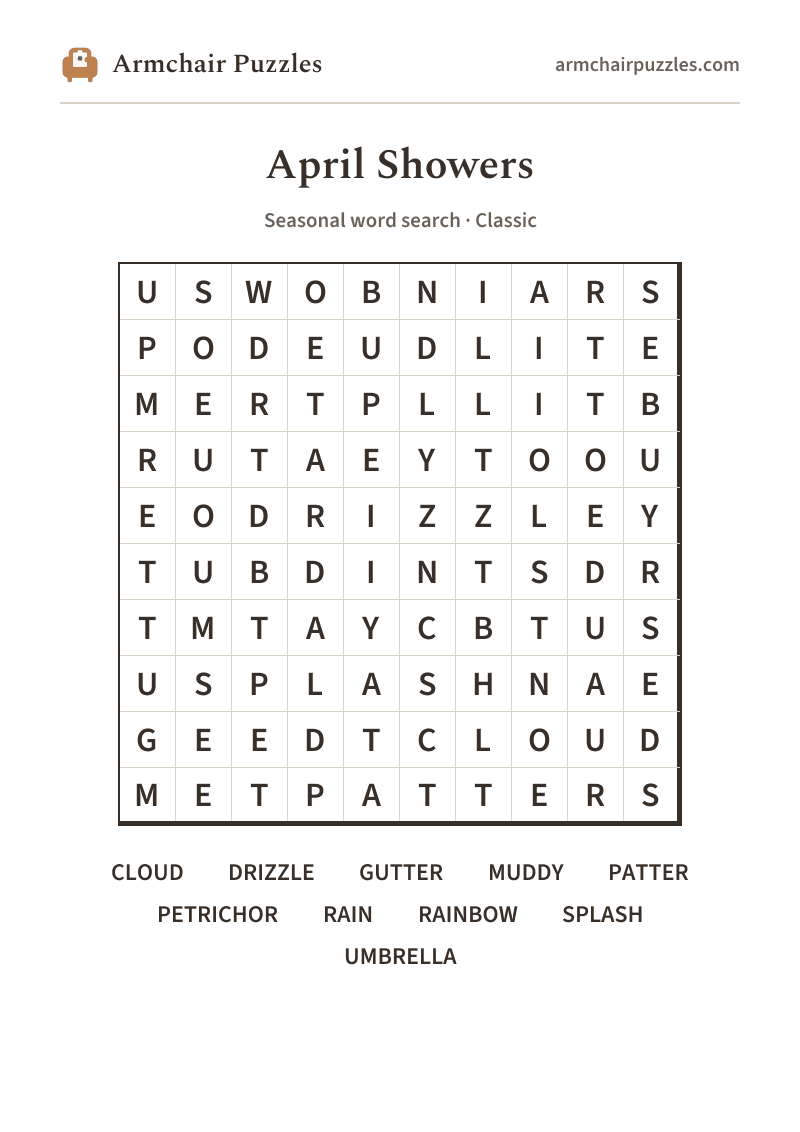
April showers word search
April Showers: a free online word search
April showers word search, free and playable online without signing up. Puddles, rainbows, and that satisfying crack when a boot hits the first ice of spring.
About April Showers
April has a reputation for rain, and it earns it. A good shower can roll in out of nowhere, turn a garden path into a stream, and vanish just as fast, leaving everything greener and smelling of wet earth. That smell actually has a name: petrichor, coined in 1964 by two Australian scientists to describe the particular scent of rain on dry ground. The rainbow, when it comes, is worth waiting for.
How to play
- 1Find a word.Tap its first letter, then tap along to its last. The trail fills in and finishes itself when it spells a word. Or press the first letter and drag.
- 2Words run in straight lines.Across and down, and on the harder difficulties diagonally and backwards.
- 3It marks itself.Each word you find takes on its own soft color on the grid and is crossed off the list.
- 4Choose a difficulty.The level you pick sets those directions and how much the word list helps, never the grid size. Tap the A buttons at the top to enlarge the letters, or pinch the grid.
Prefer pen and paper?
A clean, large-print sheet. Free, and no sign-up.
More to explore:All Seasonal word searchesPrintable Seasonal word searches