Armchair PuzzlesCalm, large-print word searches
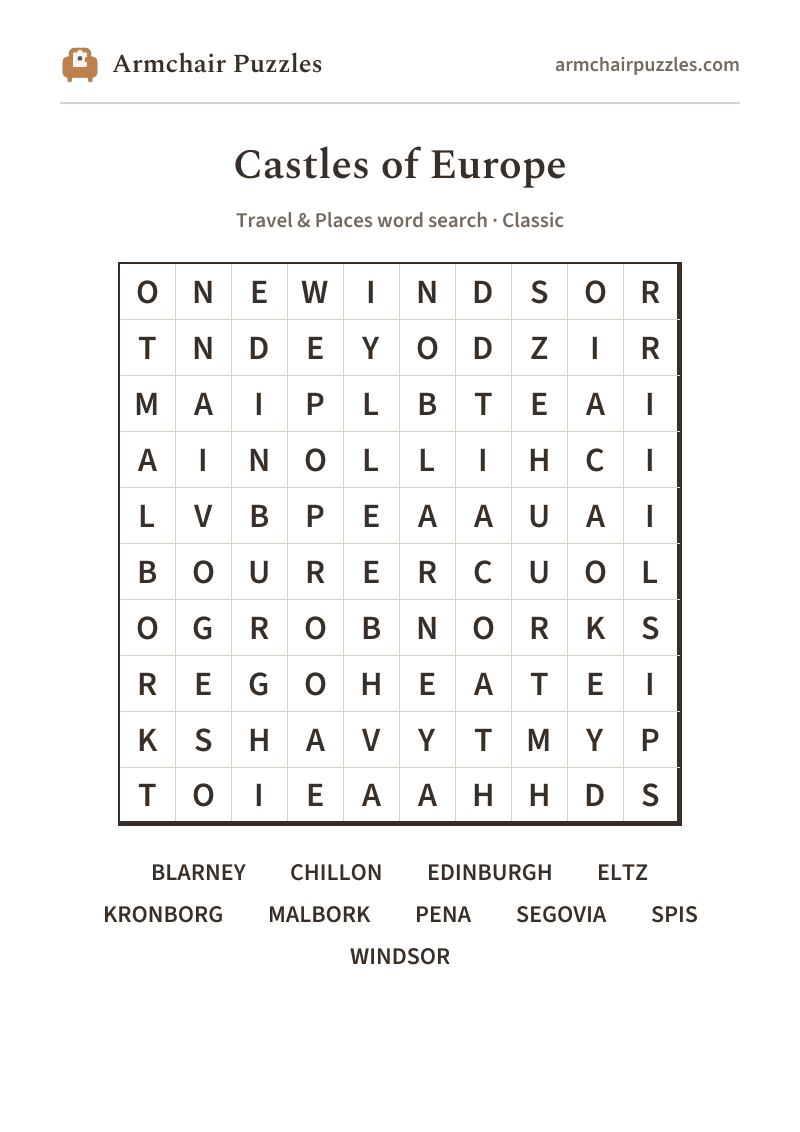
Word 1 of 10: EDINBURGH
O
N
E
W
I
N
D
S
O
R
T
N
D
E
Y
O
D
Z
I
R
M
A
I
P
L
B
T
E
A
I
A
I
N
O
L
L
I
H
C
I
L
V
B
P
E
A
A
U
A
I
B
O
U
R
E
R
C
U
O
L
O
G
R
O
B
N
O
R
K
S
R
E
G
O
H
E
A
T
E
I
K
S
H
A
V
Y
T
M
Y
P
T
O
I
E
A
A
H
H
D
S
Use the arrow keys to move between letters. Press Enter or Space on the first letter of a word, then again on the last letter. Press Escape to cancel.
A few of the words
- CHILLON
- Chillon stands on a rocky islet at the eastern end of Lake Geneva, and Lord Byron wrote a poem about its prisoner in 1816.Find this word in the grid to read its note.
- BLARNEY
- Blarney Castle near Cork is home to the stone visitors lean backward to kiss, said to grant the gift of eloquence.Find this word in the grid to read its note.
- MALBORK
- Malbork in Poland was built by the Teutonic Knights and is often called the largest brick castle in the world.Find this word in the grid to read its note.
- KRONBORG
- Kronborg in Helsingør, Denmark, is the setting Shakespeare borrowed for Hamlet's Elsinore.Find this word in the grid to read its note.
armchairpuzzles.com · free large-print word searches
castles of europe word search
Castles of Europe: a free online word search
Castles of Europe word search, free to print and play. Lake Geneva's Chillon, the Blarney stone and a good many ramparts besides.
About Castles of Europe
Europe is crowded with castles, and no two feel alike. Some sit right on the water, others perch on a rock above a river, and the one in Segovia is said to have lent its profile to a certain animated princess's home. Most were built to keep someone out, and most now let anyone in for the price of a ticket.
How to play
- 1Find a word.Tap its first letter, then tap along to its last. The trail fills in and finishes itself when it spells a word. Or press the first letter and drag.
- 2Words run in straight lines.Across and down, and on the harder difficulties diagonally and backwards.
- 3It marks itself.Each word you find takes on its own soft color on the grid and is crossed off the list.
- 4Choose a difficulty.The level you pick sets those directions and how much the word list helps, never the grid size. Tap the A buttons at the top to enlarge the letters, or pinch the grid.
Prefer pen and paper?
A clean, large-print sheet. Free, and no sign-up.