Word 1 of 10: CHOCOLATE
Use the arrow keys to move between letters. Press Enter or Space on the first letter of a word, then again on the last letter. Press Escape to cancel.
A few of the words
- CHOCOLATE
- Hollow chocolate eggs first appeared in Europe in the early 1800s. Cadbury began mass-producing them in 1875, and American candy makers weren't far behind.Find this word in the grid to read its note.
- BONNET
- The Easter bonnet tradition is old enough that Irving Berlin wrote a whole song about it in 1933. New York's Fifth Avenue parade made the decorated hat a springtime institution.Find this word in the grid to read its note.
- JELLY
- Jelly beans became an Easter staple in the 1930s, likely because their egg shape made them a natural fit for the basket. Americans eat roughly 16 billion of them every Easter season.Find this word in the grid to read its note.
- CARROT
- Leaving carrots out for the Easter Bunny echoes the older European custom of leaving hay or vegetables for Osterhase on the eve of Easter.Find this word in the grid to read its note.
armchairpuzzles.com · free large-print word searches
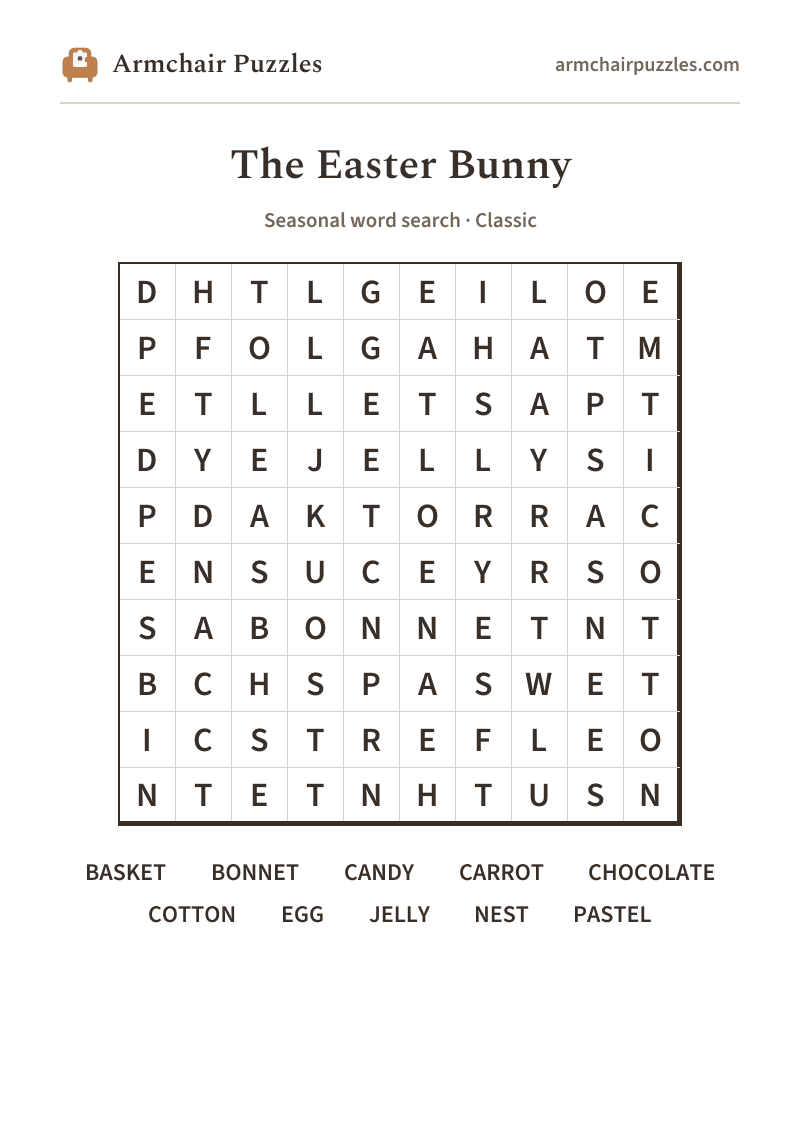
Easter Bunny word search
The Easter Bunny: a free online word search
Easter Bunny word search, free to play and free to print. The basket's already waiting, and so is that familiar hippity-hop.
About The Easter Bunny
The Easter Bunny has been leaving eggs in American baskets since at least the 1840s, carried over by German immigrants who called the tradition Osterhase. By the early 1900s, department stores were staging full Easter parades and window displays built around the basket-bearing rabbit. The chocolate egg came along a little later, but it caught up fast, and now it might be the thing children remember most clearly about the whole morning.
How to play
- 1Find a word.Tap its first letter, then tap along to its last. The trail fills in and finishes itself when it spells a word. Or press the first letter and drag.
- 2Words run in straight lines.Across and down, and on the harder difficulties diagonally and backwards.
- 3It marks itself.Each word you find takes on its own soft color on the grid and is crossed off the list.
- 4Choose a difficulty.The level you pick sets those directions and how much the word list helps, never the grid size. Tap the A buttons at the top to enlarge the letters, or pinch the grid.
Prefer pen and paper?
A clean, large-print sheet. Free, and no sign-up.
More to explore:All Seasonal word searchesPrintable Seasonal word searches