Word 1 of 10: CORSAGE
Use the arrow keys to move between letters. Press Enter or Space on the first letter of a word, then again on the last letter. Press Escape to cancel.
A few of the words
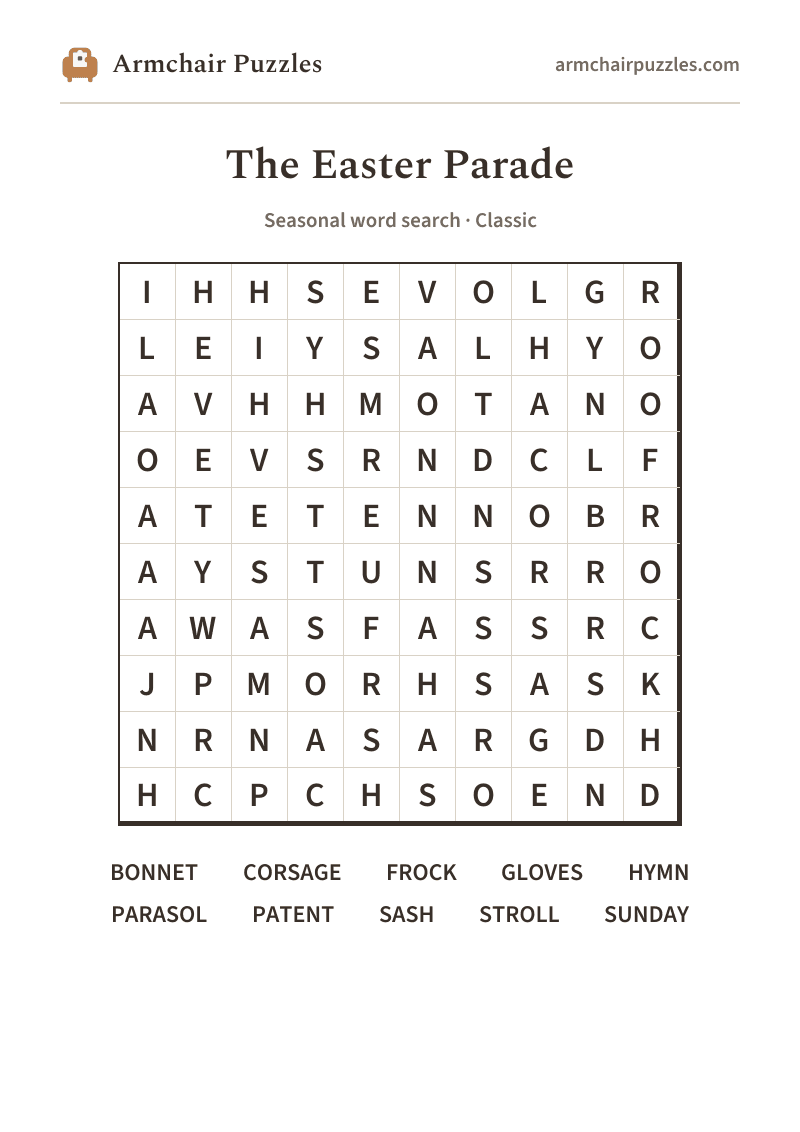
- BONNET
- The Easter bonnet is the parade's true centerpiece. Milliners in New York reported their busiest single week of the year in the days leading up to Easter Sunday, right through the mid-20th century.Find this word in the grid to read its note.
- CORSAGE
- Easter lilies were the corsage of choice for the parade. The flower was introduced to American markets from Bermuda in 1882 by a Philadelphia nurseryman, and it's been synonymous with Easter ever since.Find this word in the grid to read its note.
- STROLL
- The Fifth Avenue walk was never an organized event with permits or a mapped route. It was a slow, social stroll meant to see and be seen, nothing more official than that.Find this word in the grid to read its note.
- PATENT
- Patent leather shoes, polished to a mirror finish, were as essential as the bonnet. Children across the country knew the smell of that particular shoe polish on Holy Saturday night.Find this word in the grid to read its note.
armchairpuzzles.com · free large-print word searches
Easter parade word search
The Easter Parade: a free online word search
Easter parade word search, free to play and no account needed. Bonnets and lilies down the avenue, just like Irving Berlin imagined it.
About The Easter Parade
Irving Berlin wrote "Easter Parade" in 1933, and by the time Judy Garland and Fred Astaire sang it on screen in 1948, the song had already settled into the American Sunday-morning air for good. The real parade on Fifth Avenue in New York goes back to the 1870s, when churchgoers simply spilled out after services and walked uptown together, showing off their spring finery. A new bonnet, white gloves, a corsage of Easter lilies pinned at the shoulder: it was the one morning a year when the whole street became a kind of open-air parlor.
How to play
- 1Find a word.Tap its first letter, then tap along to its last. The trail fills in and finishes itself when it spells a word. Or press the first letter and drag.
- 2Words run in straight lines.Across and down, and on the harder difficulties diagonally and backwards.
- 3It marks itself.Each word you find takes on its own soft color on the grid and is crossed off the list.
- 4Choose a difficulty.The level you pick sets those directions and how much the word list helps, never the grid size. Tap the A buttons at the top to enlarge the letters, or pinch the grid.
Prefer pen and paper?
A clean, large-print sheet. Free, and no sign-up.
More to explore:All Seasonal word searchesPrintable Seasonal word searches