Word 1 of 10: HOLLOW
Use the arrow keys to move between letters. Press Enter or Space on the first letter of a word, then again on the last letter. Press Escape to cancel.
A few of the words
- FOIL
- Foil-wrapped chocolate eggs became popular in the US after World War II, when chocolate rationing ended and candy makers started competing for the Easter market in earnest.Find this word in the grid to read its note.
- HOLLOW
- The hollow tree trunk is the classic hard-mode hiding spot. If the kids are old enough to think of it, the eggs hidden at eye level go fast and the ones at ground level survive till noon.Find this word in the grid to read its note.
- BASKET
- The Easter basket has roots in older European customs of bringing food to church to be blessed on Easter morning. The candy version took hold in America around the early 20th century.Find this word in the grid to read its note.
- TRAIL
- A clue trail, where each found egg holds a slip of paper pointing to the next hiding spot, reportedly became popular in American Easter hunts by the 1950s as a way to slow down the fastest seekers.Find this word in the grid to read its note.
armchairpuzzles.com · free large-print word searches
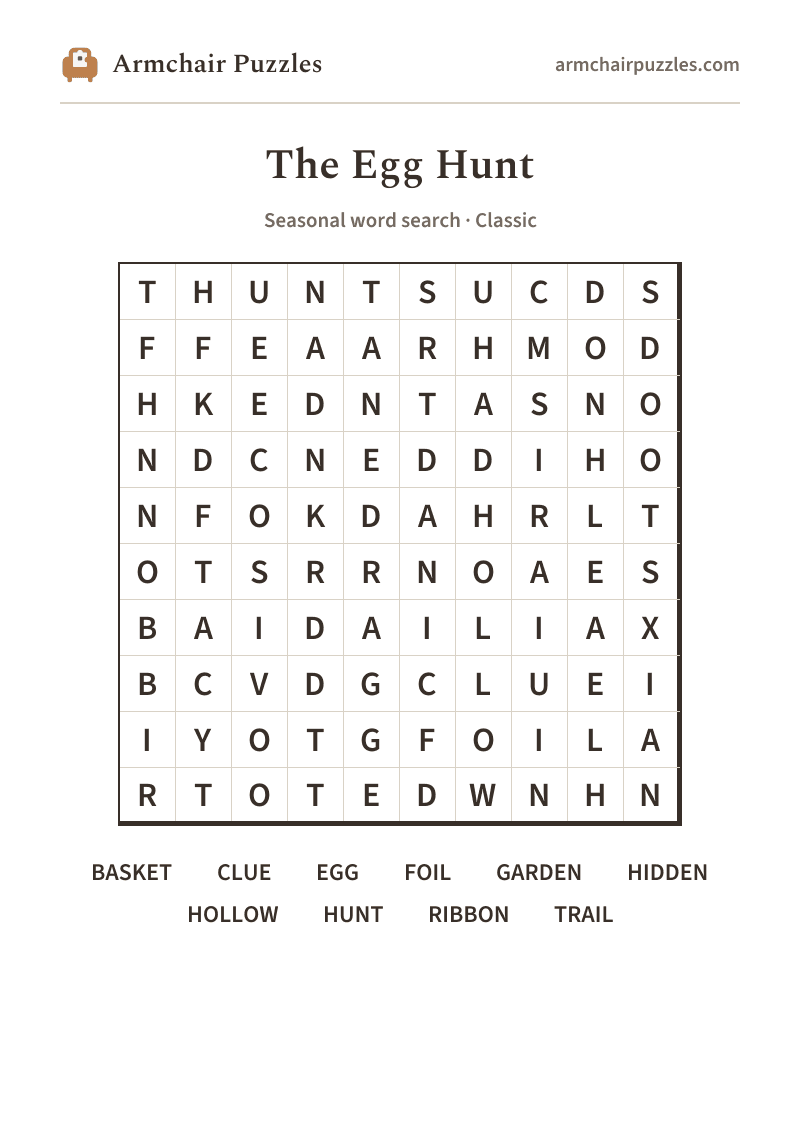
Easter egg hunt word search
The Egg Hunt: a free online word search
Easter egg hunt word search, free and printable. From the hollow log to the ribbon-tied basket, this one puts you right in the yard on a cool April morning.
About The Egg Hunt
A good egg hunt runs on suspense. Someone has to be up before the rest of the house, tucking foil-wrapped eggs behind the garden gate and under the nest of clover while the dew is still on the grass. Kids fan out across the yard clutching their baskets, and for about twenty minutes the whole neighborhood sounds like a treasure hunt. The tradition of hiding decorated eggs outdoors became a fixture of American Easter mornings sometime in the early 1900s, and the rules haven't changed much since.
How to play
- 1Find a word.Tap its first letter, then tap along to its last. The trail fills in and finishes itself when it spells a word. Or press the first letter and drag.
- 2Words run in straight lines.Across and down, and on the harder difficulties diagonally and backwards.
- 3It marks itself.Each word you find takes on its own soft color on the grid and is crossed off the list.
- 4Choose a difficulty.The level you pick sets those directions and how much the word list helps, never the grid size. Tap the A buttons at the top to enlarge the letters, or pinch the grid.
Prefer pen and paper?
A clean, large-print sheet. Free, and no sign-up.
More to explore:All Seasonal word searchesPrintable Seasonal word searches